Last weekend IES Abroad took us to Nara, the first capital of Japan. We went by bus, and arrived 3 hours after leaving Nagoya.
We met up with volunteer guides from Nara, and went first to Todaiji, the temple with the largest bronze Buddha statue.
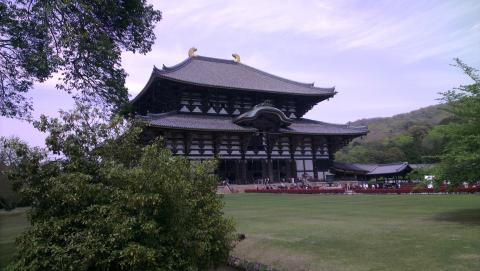
Todaiji.
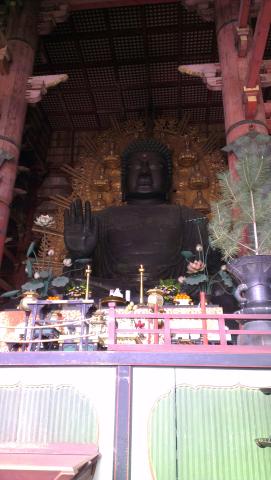
The world’s largest bronze Buddha statue.
There are, of course, a lot of deer around Nara! You could buy deer biscuits (shika senbei) to give them.
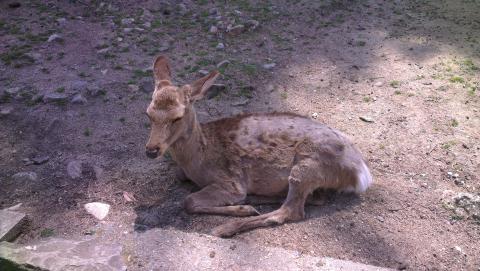

A sign warning tourists against deer.
We stayed at a ryokan (Japanese inn) called Mikasa, with a great view of Nara at night.
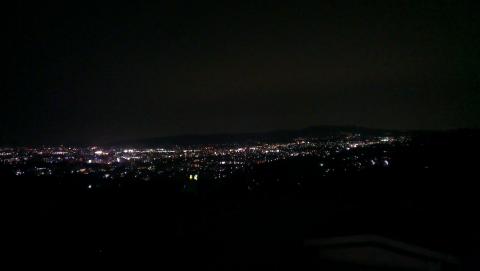
View of Nara at night from the ryokan.

We got to choose our own styles of yukata to wear in the ryokan!

Breakfast at the ryokan.
The next day we went to the top of Mount Wakakusa.

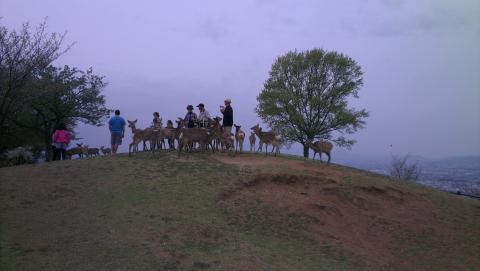
This is what happens when you are near the deer in Nara with a bag of snacks…
Afterwards, we went with a volunteer guide to Toshodaiji Temple. It was built by Ganjin, the Chinese priest invited to Japan to teach Japanese monks “real” Buddhism.


If you have noticed, the roofs of the main halls in temples Nara have two curved structures on them. They are meant to represent fish tails, which means that the whole temple is immersed in water, and this acts as a symbolic protection against fire.
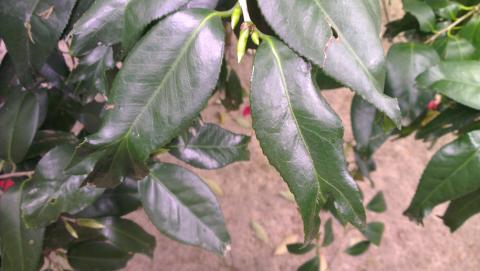
The guide also showed us kingyo-tsubaki, a kind of camellia tree with leaves that look like goldfish! He told us that this certain type of tree is very rare, and that there are only three of them in Japan.
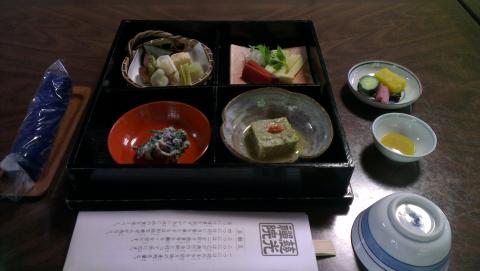
Afterwards we went to a temple to have Shojin Ryori, which is vegetarian cuisine eaten by Buddhist monks in Japan. No meat or eggs were used, and everything was prepared in a beautiful way. I did not know that such a wide range of tastes and textures could be made from just tofu and vegetables.