8161 - 8170 of 19351 Results

Breana Ross • Global Citizen of the Year Award

Breana Ross, our 2018 Global Citizen of the Year, smiling at the oceanfront
Breana Ross
page_speaker

IES Abroad Program: Cape Town Customized Program

College/University: University of Miami, Class of 2019

Majors: Broadcast Journalism and Political Science, Africana Studies minor

Hometown: Clinton, Maryland

Global Citizen of the Year Award • 2018 Winner

Breana's Story

In your application for this award, you reflected on the beginning of your experience, saying, “I want to say there were a lot of factors that I took into consideration when I decided to study abroad in Cape Town, South Africa, but that would not be true…I heard the words ‘service learning’ and ‘youth’ and that was it.” Tell us more about this point in your journey.

I always knew that I wanted to travel the world but I knew that I did not want to do so in a way that would only benefit me. I did not want to just travel the world. I wanted to serve the world.

A few months before I decided to study abroad in South Africa, I went on a trip to London with my school for a week. I had a great time but something was missing. It did not feel right for me to be taking in all of these experiences in this new place without giving anything in return. That is when I knew my study abroad experience needed to be different.

My mother always told me about how her mission trip to Haiti transformed her life and her world view. She was serving in Haiti while also learning from their way of life. That is the type of experience I wanted. Since I had grown up working with youth at my local homeless shelter and through my service program at the University of Miami, Written in My Soul, I knew I wanted serving youth to be a part of my experience as well.

All of this led up to the conversation I had with my study abroad advisor. “Which programs offer a service component?”, I asked the advisor intently.

“Well our Cape Town program is the only program that offers a service learning component. Through this you can work with youth in schools, at medical clinics, or any sort of service you choose,” the advisor replied.

I heard the words “service learning” and “youth” and that was it. It was decided.

I did not yet know much of anything about the place in which I’d spend 6 months. I just knew that I would have the opportunity to serve youth who look like me and who, like me, are historically disadvantaged. I was hungry to serve, even if it was in a place I hardly knew a thing about. I guess that is what true passion looks like.

Your passion for storytelling and commitment to service have guided this difference you have made in the world. If you could sum it all up, how would you describe the positive impact you’ve had in the world through study abroad?

I think my experience abroad can be summed up with three main points: a passion for service brought me to South Africa, bridging my culture with others led me to have powerful experiences, and my thirst as a writer and storyteller allowed me to share those experiences with a global audience.

Through my study abroad experience in Cape Town, I was able to work with SHAWCO Education, a student-led service organization at the University of Cape Town. The mission of SHAWCO Education is “to practice and promote responsible citizenship in the South African context through health, education, and social entrepreneurship.”

Through SHAWCO, I was able to teach Reading and Math to 2nd and 3rd graders in Nyanga, a black township, and in Manenberg, a coloured township. I had a positive impact on my students, not only because I taught them Reading and Math while also teaching them about my language and culture, but also because I allowed them to teach me about their language and their culture as well. I did not act like I was the only person in the room that had something significant to teach and share. I placed value on what they could teach me as well.

As far as the storytelling aspect of my study abroad experience, I used my blog to write about lessons I’d learned about my own racial identity, the destitute poverty I witnessed on the day to day basis, and how racial issues were discussed much more freely, openly, and honestly in South Africa than in the United States.

I was also able to give others a platform to share their experiences through a video story I did on a local restaurant owner in the township of Langa, which gave her business publicity while also sharing a powerful story with a global audience.

Using my love for writing and storytelling allowed me to not only reflect on the experiences I was having, but I was also able to share my blogs and stories with an audience both in South Africa and back home in the United States to spark meaningful dialogue.

For many of my friends and family back home, my blog was a window into a world much different from what they know. In addition to sharing my perspective on my own blog, I was also able to share my perspectives as an American in South Africa through an article I wrote for the University of Cape Town’s newspaper. This article gave South African readers a taste of the experience of an American student through my eyes.

In sharing your experience teaching in Cape Town, you used the phrase “mutual learning experience.” What does this mean to you? And why is it so important?

Through my eyes, a mutual learning experience is one where both the student studying abroad and those they are interacting with in the community where they are studying benefit and grow from the study abroad experiences.

It is very easy for study abroad students to come to their host country and engage in learning experiences without sharing parts of themselves and allowing their host community to learn from them. It is also easy for study abroad students, specifically service learning students, to have a “savior complex” where they believe they are saving the community they are working with and teaching them while not being open to absorbing what they could learn from those they are serving.

Neither approach is best for maximizing an experience abroad. It is important to share parts of yourself and your culture with others while also being open to learning about their culture and their ideas.

What did you learn about the world through your experiences in Cape Town?

I learned that, while places and people around the world share differences, we share more similarities than we think we do.

While in South Africa, I realized that the country shares many of the same issues that plague America: poverty, racial tensions, and inequality in housing, education, and health care. Though these issues were more pronounced and more drastic in South Africa than they are in America, the way that South Africans addressed these issues was, in my opinion, much more progressive than the way Americans do.

South Africans do not shy away from uncomfortable topics. In fact, they spoke about race, and other topics that Americans would shy away, from openly and freely. For me, engaging in dialogue openly is the first step towards progressive action and change. Though America is considered the “leader of the free world,” there is a lot we can learn from countries that share the same issues we do.

What did you learn about yourself?

Perhaps the most important thing I learned about myself is that I am capable and independent enough to survive and thrive in a country that is completely foreign to me. I knew that I was adaptable, but the experience gave me the confidence and reassurance I needed to know that I would be able to move anywhere I need to in pursuing my career in journalism.

I also learned that I have a thirst to travel and experience new things. I did not realize how much I loved traveling until after my study abroad experience.

On a less positive note, I learned that my own racial identity is a lot less certain than I thought it was. As an African American, my experience in South Africa was sobering as I realized how much of my own culture and heritage was lost in the slave trade. I have now become hungry to know where I come from and where my roots lie.

“I don’t believe it is enough to go somewhere, have enriching and enlightening experiences, and then keep all that you have seen and learned to yourself. I think a large part of global citizenship is sharing eye-opening ideas and experiences that are realized while abroad with a global audience.”

Breana Ross • University of Miami • Cape Town - Customized Program

What role do you believe writing and storytelling plays in global citizenship?

I don’t believe it is enough to go somewhere, have enriching and enlightening experiences, and then keep all that you have seen and learned to yourself. I think a large part of global citizenship is sharing eye-opening ideas and experiences that are realized while abroad with a global audience.

Writing and storytelling helped me to do just that. I didn’t just keep the things I was seeing, learning, and experiencing to myself. I used my blog and my videos to share those experiences with a global audience and give them a look at a different part of the world through my eyes.

How has this experienced shaped your future? What’s next?

My experiences in South Africa have made me both a better servant and a better storyteller.

I now think of my service program, Written in My Soul, as a mutually beneficial learning experience rather than just my volunteers and I solely teaching the kids. I let my students share parts of themselves and teach me about their world as well. I use this to connect with them on a deeper level and build bridges, just like I did in South Africa. I believe this mindset will help me as I move towards expanding Written in My Soul into an official non-profit organization.

As a storyteller, I now think of my stories as providing a window into a world different to that of my viewers. I look for stories that tackle social issues, issues that Americans may find uncomfortable but South Africans would proudly and comfortably discuss.

I use my journalism as a voice for those that are sometimes viewed as voiceless. I, now, not only want to use my journalism career to report on national issues, but also international issues that often are overlooked and unnoticed. I think this passion will set me apart from other journalists as I begin my journey as an on-air reporter.

Perhaps most importantly, my experience abroad has helped me to adopt a new attitude, one that has rubbed off on many of my friends and family as well. I now have a joy and zeal for life that stems from my focus on what I have and not on what I don’t have. I learned that from eighty little 2nd and 3rd graders in Nyanga and Manenberg.

If you could give one piece of advice to future study abroad students, what would it be?

Enter your study abroad experience with an open mind, positive attitude, and a willingness to soak up all that you can from your host country.

However, make sure that you are also contributing something to the country where you are studying. Whether you are serving in the community, sharing your gifts and talents with others, or simply informing others about your culture and where you come from, make sure that you are serving the area where you’re living in some way

Try to do as many new things and step outside of your comfort zone as much as you can! This will help you make memories that will last a lifetime!

Want to hear more about Breana's story? Read how her experience studying and volunteering in South Africa influenced her identity in significant and surprising ways.

To further promote the value of service, Breana gave a TEDx talk at University of Miami on Wednesday, April 24th, titled “The Impact Money Can’t Buy”.

Breana Ross | Our 2018 Global Citizen of the Year

Pheonix Pittman • Global Citizen of the Year Award

pheonix_0
Pheonix Pittman
page_speaker

IES Abroad ProgramBuenos Aires – Latin American Societies & Cultures

College/University: Spelman College

Majors: International Studies, Spanish

Hometown: Boerne, Texas

Pheonix’s dedication to maternal health and encouraging black students to study abroad is a multi-faceted commitment to global citizenship that thoroughly impressed our international jury. Pheonix worked with children at a not-for-profit in Buenos Aires engaging them on subjects from healthy fruits and vegetables to outer space and other countries. She even assisted the organization to improve the strength and retention rates of their volunteer program after she returned to the States.

Additionally, Phoenix used her voice to advocate for her peers needs while they were in Buenos Aires, and shared her many experiences though blogging and social media to encourage black students to study abroad. She reminded us of the varied ways global citizens can use their voice to positively impact the world around them.

Global Citizen of the Year Awards • 2019 Finalist

Pheonix's Story

IES Abroad: Take us back to the beginning of your study abroad experience. What made you want to study abroad? Why Buenos Aires? How did your journey begin?

Pheonix Pittman (PP): When I was in middle school and preschool, actually, I lived in Germany because my dad was in the Army. So, after I had lived abroad, I knew I wanted to study abroad in college.

Then, I knew I wanted to go to Spanish speaking countries because that was the language I was learning. I choose Buenos Aires because I had not been in South America. I really wanted to explore something new. And then the city of Buenos Aires specifically because I had talked to some other Spelman students who had gone abroad. They had a lot of positive things to say about their experience there.

IES Abroad: You mentioned in your application that you were passionate about maternal health before leaving to study abroad. What sparked that passion for you? 

PP: So, I actually went to a talk on campus where we had some midwives come and speak about maternal health in the black community specifically. And so, that is when I first learned about the disproportionately high maternal mortality rates for black women in the United States. The discussion really stuck with me. And there is a lot of women in my family who have had issues with reproductive health.

Later in an international studies class, I did some research on maternal mortality in Argentina, and I found that they have higher rates than their neighboring countries, Uruguay and Chile. I really enjoyed learning about the social factors, like race and gender that caused a lot of the poor outcomes and maternal health.

So that’s kind of what sparked my interest to do that service abroad. I wanted to see it sort of on the ground and see it from more perspectives than just the hospital setting.

IES Abroad: Could you elaborate a little bit more on what those factors were, particularly for black women in the United States, and what you learned about Argentina in you research?

PP: In the States, what is interesting is that your economic class does not really improve your maternal mortality outcomes for black women. A lot of people think that it is because majority of black women are in more poor situations. And it’s just not the case.

So even when women have degrees and they have more money, there is still bias with doctors. They do not care for black women in the way they are supposed to. They do not believe them when they say that they are in pain or that their pregnancies are high risk. And so, then they just sort of fall through the cracks.

When I did my research in Argentina, I also found research that there is lots of proven methods to fix a lot of the issues that women were coming into the hospital with, but doctors just would not implement them.

[This was connected to the] machismo culture of men thinking that they know more than women or not listening to women when they talk about their bodies. Women not even knowing going into the doctor’s office what could possibly be wrong and how the doctor is supposed to treat them. And so those social factors of race and gender—race here in the States and then gender in Argentina—are really what kind of make these issues arise.

IES Abroad: How did your study abroad experience influence this passion?

PP: My work with [Fundación Pilares-CONIN] really helped me to learn more about other aspects of maternal health issues beyond just the birth. So, poverty and access to medical care look very different in Argentina and the United States. But my service that I did in Argentina really helped me see that mothers in both countries are facing a lot of the same problems and it made me eager to learn more.

IES Abroad: You also shared that you are passionate about seeing more black students decide to study abroad. This encouraged you to share your experiences studying abroad as a black woman through your IES Abroad blog, Instagram, and as the first Study Abroad Ambassador for HBCU Pulse. What did you feel was the most important thing for you to share through these platforms?

PP: In my blogs, rather than focusing on the sights of the city that I was seeing or parts of my every day to day life. I tried to focus a lot on how I was feeling at different points in my study abroad experience. I also put my Instagram link on there and opened up my DMs so that so that people could ask me questions directly if they wanted to.

This was very important for me because I think one thing that blocks a lot black and HBCU students from studying abroad is money. But other than that, I think a lot of people are really daunted by the idea of going to a new country alone and without the community that they are used to having in their classrooms.

I felt that if I was open about how I was feeling during my semester, future students might feel that they had someone to relate to, ask questions to, and eventually they might feel empowered to go abroad as well.

IES Abroad: You wrote that sharing your experiences in these ways was an “unexpected joy” – tell us more about that.

PP: So, knowing that I had to write blogs about my experience forced me to be more present in each moment and to survey myself and how I was really ingesting everything that I was experiencing. So then rather than just going through the motions of going to class and travelling on the weekends, in everything that I did I was always thinking, "How does this make me feel? What lesson am I learning from this?" things like that.

Living day to day with that mindset and then getting to share the results of that sort of thinking with others gave more meaning to my study abroad experience. And I really enjoyed that.

IES Abroad: What did you learn about the world through your experiences in Buenos Aires?

PP: Surprisingly, I learned a lot about the perceptions of citizenship and nationality. Buenos Aires is a city with a long history in immigration, especially from Europe and then now sort of within South America as well.

One thing that was really mind-blowing to me was talking with my host mom and her family. Most of them have citizenship in multiple countries, which is just something that is almost unheard of in the United States. But it is very common in Buenos Aires.

It was just striking to me how much focus we put on citizenship in the States, how hard we make it to be a citizen, and even people who could be citizens of other countries through their ancestry and just do not even think about it. It was just really eye-opening to see how fluid the idea of citizenship and nationality can be in other places in the world.

IES Abroad: What did you learn about yourself?

PP: I learned a lot about the type of service that I do not want to do in the future and how to deal with stressors that come my way. When I was working with Pilares, I was primarily doing childcare for toddlers. And while I really enjoyed being in that environment and learning, I also learned that I do not really like working with toddlers! …I think that was something that was a good learning experience that I can use in the future.

And then I was able to travel a lot while I was abroad. And so, there is nothing like traveling nonstop to make you realize what stresses you out and learn how to deal with it really quickly. That was a good learning experience for me as well.

IES Abroad: How has your study abroad experience shaped your future? What’s next for you in the short-term? What kind of world do you want to help build in the long-term?

PP: My study abroad experiences really gave me the space to think about what is really important to me. It gave me time to think about prioritizing my mental and physical health above sort of the accolades that it seems you always need to be chasing when you are on campus. It really helped me reevaluate some of my goals and prioritized myself more.

And so, in the short-term, I'm going to be graduating next spring and after that, I plan to get my Master's in Business Administration. So, I will be applying to grad school within the next year.

In the long-term, I would like to build a world in which people are not shocked by the diversity within racial and ethnic groups – and that's a lot to ask – but I think that if travelers went to a country without the limiting expectations of how they'd be treated. And if the local people had a more open mind about the types of people that they might encounter that are coming to visit, then everyone would feel more comfortable in this process of going abroad to other countries, and just in our more interconnected world.

IES Abroad: Thinking about yourself and your peers who will be graduating in the next year or so, what do you think are some of the biggest challenges you anticipate facing?

PP: I think that my peers and I have spent most of our formative years in a very polarized world. And I can be guilty of this myself, and there is some issues that I do not believe that there is a lot of room for compromise.

But I think that in general, the unwillingness to get to know someone and their views before we decide to cancel them will end up really hurting us down the line. I hope it is something we can work through.

IES Abroad: What do you think are some important skills and qualities that you and your peers will need to carry with you to face these challenges?

PP: I think the most important thing is to be willing to apologize when you have done or said something wrong or offensive to someone. And to actively listen to others with an open mind, rather than just passively listening so that you can form a rebuttal response to them.

I think that studying abroad is a great way to build on those skills because you are really forced to put yourself in an environment where you might not agree with everyone and have those conversations.

IES Abroad: You are a student that has inspired us through your application and your story. Who is a peer that inspires you? Whether that is someone you know personally or someone you look up to from afar.

PP: Someone that inspires me is Jayden Smith and that is because he is really a model of doing what he can from where he can. And there is Toni Morrison quote, "Do what you can from where you can."

One thing that he did – I guess kind of recently – was intervene in the Flint Water Crisis. Which is still going on and has been going on for years; the government has not fixed it. He had the means and ideas to go in and make an intervention that is really helping lives. Without having the degrees or having a whole organization, he is just doing what he can from where he can. And that is something I really admire.

IES Abroad: If you could give one piece of advice to future study abroad students, what would it be?

PP: My piece of advice would be do not forget to rest and do not think that you have to push yourself too far. Because it is very easy to get caught in the hype of traveling and feeling like there is always something going on that you are going to miss out on. But if you do not take the time to rest, you will not be able to really enjoy anything.

IES Abroad: Any final thoughts you want to share?

PP: Well, I am really excited about the award because I think when people think about studying abroad, they don't necessarily think about doing community service. But I think that is something really important to any abroad experiences; going in thinking about the people that live there and not just what you can get out of it.

Through doing service, you also get a lot out of it personally. And that was my experience and so I hope other people decide to do it as well.

“I think that in general, the unwillingness to get to know someone and their views before we decide to cancel them will end up really hurting us down the line. I hope it is something we can work through.”

Pheonix Pittman • Spelman College • Buenos Aires – Latin American Societies & Cultures

Pheonix Pittman |  2019 Global Citizen of the Year Finalist

Sara Jacques • Global Citizen of the Year Award

sara_0
Sara Jacques
page_speaker

IES Abroad Program: Santiago – Politics, Social Justice & Language

College/University: Penn State University

Majors: Public Relations and African American Studies with minors in Spanish and Global & International Studies

Hometown: Kearny, New Jersey

Today, climate change and sustainability are critical topics globally, and incredibly important to Gen Z. Our international jury of IES Abroad staff were impressed by Sara’s commitment to making a positive impact on our environment by initiating a recycling program at the IES Abroad Santiago Center and ensuring the program’s sustainability. Through Sara’s development of this program, she became more aware of the disproportionate effects of climate change on countries such as Chile that produce such a small amount of the world’s greenhouse gases.

Now, back on her on campus in the U.S. she is still working with the Center to ensure the longevity of the program, making her own lifestyle changes, and engaging in informed conversations with her local community to continue her commitment to looking after the environment.

Global Citizen of the Year Award • 2019 Finalist

Sara's Story

IES Abroad: Take us back to the beginning of your study abroad experience. What made you want to study abroad? Why Santiago? How did your journey begin?

Sara Jacques (SJ): I came into college knowing that I wanted to study abroad because it seemed like a really cool opportunity, but I never knew where I wanted to go or what I wanted to do. Then I started a Spanish minor and figured out that I could finish it really easily if I studied abroad in a Spanish-speaking country. 

It seemed to me like everyone at Penn State went to Spain or Barcelona, so I started looking for something different. I was between Santiago and Buenos Aires, and the program in Santiago just ended up fitting my interests more. I essentially study social justice, and know that’s what I want to dedicate my life’s work to, so to be able to learn about it in an entirely new context felt like a pretty serendipitous opportunity. 

IES Abroad: What advice would you give to others looking to start sustainability programs or efforts in their own place of influence whether that be their school, office, community group, etc.

SJ: I would say definitely work with the community and not just for them because so much of how I understood the problem was through my own cultural lens, which obviously was much different in Chile. The solutions that work at home weren’t really applicable in the new setting. Rules were different, attitudes were different, it was definitely a learning process, and being really open to that learning process I think, is what made the program so successful. 

Especially with sustainability programs, it's important to make them...sustainable. If the people who are ultimately living with it don’t have the tools to maintain it once you leave, it’s probably going to flop. 

IES Abroad: In reference to all you learned about the effects of climate change while studying abroad in Santiago, you wrote, “My abroad experience made me much more critical of social and cultural norms.” Can you share more specifically about those norms you became critical of?

SJ: In relation to environmental concerns, I want to say that [I became more critical of] the act and process of recycling. In the States, I feel like that's where a lot of our energy is, and what a lot of our media focuses on. 

I mean, recently, we’re coming to realize that recycling systems aren’t reliable...but I don’t think we talk enough about why. We really just waste too much, and systems can’t handle it. Recycling can’t be the end all be all...it’s more about reducing our waste. For a long time I was, admittedly, a hopeful recycler and thought if I put my trash in the right bin it would just disappear from the earth and all would be well. 

Basically, I say all of this to say, I became more critical of the end point, which made me a lot more conscious about my own waste patterns. 

IES Abroad: After recognizing these criticisms, what was your next step personally to address these issues?

SJ: Yeah, so again, instead of relying on recycling, I really focus on reducing and reusing what I have. It’s actually really fun and creative to reuse things that would have otherwise been in the garbage...like as we speak there’s quinoa in a peanut butter jar in my refrigerator.

I never leave my house without a canvas bag and reusable utensils in case I end up having to stop at the store on my way home or eat out. These little things take up literally no space and make such a big difference. Reusable water bottles and coffee cups are definitely staples too. 

I just came from lunch with a friend and consciously felt really good about pulling that reusable fork out. And like, it’s just a fork, but if it’s a fork a day that adds up like crazy. It’s the same thing with bags. 

There’s no need to create an eternal life for a plastic bag when you can just pull out a weightless one that has less of a chance of breaking. I think a lot of times people don’t do these things because they’re outside routine, but all it really takes is a one-time adjustment and the benefits are tenfold. You wonder how you ever lived before, haha.

IES Abroad: What did you learn about the world through your experiences in Santiago?

SJ: Well when I got to Santiago I really couldn’t speak Spanish. I think I learned a lot about humility and patience on a personal level just trying to navigate that. My empathy expanded enormously, especially in respect to the whole topic of immigration in the States right now. 

I was in, arguably, one of the most privileged positions when I was in Santiago. I was a student, I was taken care of by so many people, if I needed to talk to someone in English to hash out my feelings or figure out a problem I was able to do that. 

So often people drop everything and come to the U.S. escaping crisis in the best interest of their loved ones, and then on top of that deal with the same daily stressors I experienced, probably to a much higher degree. It’s just like, I would really sit and cry and live with a consistent headache for the first two months because I felt so helpless...and that was an experience with privilege. 

I just feel really lucky to be born into the life that I was, and grateful for the perspective these experiences in Santiago gave me. 

IES Abroad: What did you learn about yourself?

SJ: Honestly, this sounds kind of corny, but I learned that I'm capable.

It's really easy to get into a grove when you're in comfortable spaces like home or your university, but to be able to do that when you’re thousands of miles from your comfort zone was really awesome. It definitely gave me a new sense of confidence, which bled into every other aspect of my life from school to work to relationships. I feel like I’m more empowered to share perspective and be more genuinely myself.

IES Abroad: Do you have some examples of when you felt that you were growing in your confidence while studying abroad?

SJ: At the end of the semester, I met with a woman at the Chilean Ministry of Environment, Jessica Ulloa Mendieta [who is also an IES Abroad faculty member]. I remember pulling up to the office and seeing the government crest outside and literally saying out loud to myself, “how on earth did I get here?” 

I literally sat with a government official talking about environmental concerns, in Spanish, for an hour. We looked through community plans and talked about programs. I felt so empowered. None of that was in my original plan when I came to Santiago.

IES Abroad: That's super cool. How did you end up in that situation? How did you make the connection with the government official in the ministry?

SJ: She was teaching a course for IES Abroad to another program. And Maricarmen [the IES Abroad Santiago Center Director] told me that she wanted to introduce us based on my interests. I didn’t know who she was at all, but of course I said yes. 

I assumed I was just going to meet in her university faculty office or something, and then when I got to the address, and it was literally the Ministry of the Environment, I was like, "Am I in the right place?” I double checked the address. 

Like I said, she was talking to me about a lot of planning and programs, and showing me the supporting materials. To be able to read and understand these things in Spanish was just so surreal. Honestly, even to think about this now it’s crazy...I can’t believe that happened. 

IES Abroad: How has your study abroad experience shaped your future? What’s next for you in the short-term? What kind of world do you want to help build in the long-term?

SJ: So in the short-term, I actually just got accepted to teach in Spain for the 2020-2021 school year which I’m really excited about. I absolutely fell in love with the Spanish language, and what it taught me about myself. I really want to develop that a little more and have some more international experience before I enter the “real world.” 

Learning a second language for me was like escaping the logic I’ve always lived my life in...it’s hard to explain but I just really loved how it challenged me to think and speak in different ways. Then you internalize that and you just feel different. 

As for long-term, I'm really invested in social justice so that’s what I want to do in some capacity. I feel like being on the social justice program in Santiago really opened my eyes to different ways that that's possible. I learned so much about economic policy and how that contributes to inequality...like I had never known anything about the Washington Consensus. 

I was never all that invested in environmentalism until my time abroad either, so now that that’s really central to who I am. I’m thinking that eventually I want to work toward environmental justice. I love communicating and storytelling, and I’m grateful that can take me in so many different exciting directions. I don’t know, we’ll see!

IES Abroad: Thinking about yourself and your peers who will be graduating in the next year or so, what do you think are some of the biggest challenges you anticipate facing?

SJ: I feel like, obviously, I need to say climate change! Yeah, it's unprecedented what's happening right now. And the fact that money and power are overriding these serious existential threats is super unsettling. It would feel defenseless if there weren’t so many little things we can do as individuals. 

Your voice matters. Being knowledgeable and having conversations matters.  Voting matters. Voting with your dollar matters. 

IES Abroad: What do you think are the most important skills and qualities you will all need to carry with you to face these challenges?

SJ: Critical thinking is really important. When we're just constantly fed information and taught to regurgitate it rather than question it, it's detrimental to our progress.

I think we need to be more cautious about the information we consume, the things we say, and the implications they have. I think just being more mindful and conscious about how we live our day-to-day lives, rather than being so hung up on an end game can go a long way in creating a better world. 

IES Abroad: Who is a peer that inspires you; whether that’s someone you know personally or have looked up to from afar?

SJ: I loved this question. My best friend Allie at school inspires me so much. She is the most democratic – by definition – person I know. The way she approaches problems and challenges herself to question her own beliefs seriously inspires me. She challenges me to think outside of boxes I don’t realize I’m in, and be more empathetic, especially when it’s hard to be.

It’s so easy for us to only be around people who have our same beliefs and don’t make us question ourselves. While Allie is probably one of those people to me, she actively keeps me aware of it. We have critical conversations and play devil's advocate for fun. I feel like our friendship is really holistic and I feel so lucky to have a person like her in my life. She’s really helped me grow on all fronts.  

She’s also the person who sparked my interest in environmentalism in the first place now that I think about it. I wouldn’t even be having this conversation if it wasn’t for her influence in my life. She’s just such a good person. So wise beyond her years. Having someone like that on your side is a crazy blessing. 

IES Abroad: If you could give one piece of advice to future study abroad students, what would it be?

SJ: Go somewhere different! Go somewhere that's going to challenge you to leave your comfort zone. I mean, studying abroad anywhere forces you to leave your comfort zone, but I picked Santiago because I knew it would be hard. Now that I look back, none of the hardships are how I remember my time abroad. It was literally the most beautiful, amazing, enlightening, rewarding experience of my life, and as cliche as it sounds...made me who I am today. It was the best stress, and I feel like after that, I can really do anything.

“Your voice matters. Being knowledgeable and having conversations matters. Voting matters. Voting with your dollar matters.”

Sara Jacques • Penn State University • Santiago – Politics, Social Justice & Language

Sara Jacques | 2019 Global Citizen of the Year Finalist

Yazmin Baptiste • Global Citizen of the Year Award

Yazmin Baptiste headshot
Yazmin Baptiste
page_speaker

IES Abroad Programs: Rabat – Study in RabatRome – Sociology & Religion

College/University: Lafayette College, Class of 2020

Majors: Anthropology and Sociology, Religious Studies minor

Hometown: Queens, New York

Yazmin was the clear choice for the 2019 IES Abroad Global Citizen of the Year. She is the only applicant who challenged the term global citizen and what it means.

Yazmin respectfully, empathetically, and proactively demonstrated that the communities who are not recognized through citizenship are individuals who can make just as much of an impact as those of us who are documented citizens. This is a much enlightened and humanitarian perspective that is rare but needed in today’s society.

Her volunteer work with immigrant and refugee communities in Rabat, and her research into the negative impact that for-profit companies have on immigration in Italy, illustrates her understanding of immigration beyond a U.S. context and further emphasizes her dedication to supporting communities who are not recognized through citizenship.

Yazmin also successfully articulated how she continues to apply her experiences abroad in community engagement and research after returning home. At Lafayette College, she is creating a Mental Health Invisible Tour inspired by a tour of migrant experiences in Rome. She is also continuing research on immigration conducting fieldwork in Texas and New York City on privatization and immigrant detention in America.

Global Citizen of the Year Award • 2019 Winner

Yazmin's Story

IES Abroad: Take us back to the beginning of your study abroad experience. What made you want to study abroad? Why Rabat and Rome? What made you decide to do two semesters?

Yazmin Baptiste (YB): When I decided to study abroad, I was going through a difficult time in college. I had always planned on studying abroad, but I didn't really know where to begin. I decided my first step was to figure out how to get financial aid to go. I went to my financial aid office, and, luckily, they said that I could study abroad with my scholarship.

And so I was like, "Okay. Now the next step is to find out where to go." And I chose Rabat first because I'm a Religious Studies minor, and I definitely wanted to study Islam as one of the main religions that I focused on.

Then through my time being in Rabat and learning about immigration, I realized I have so much more to learn about immigration and decided to go with Rome, Italy because they have a Sociology & Religion program that has a lot of immigration courses. And I thought that was the best fit for my academics and my interests.

I really wanted to do a year but, again, the financial issues. So I called my school back when I was in Morocco, and I was like, "Hey, can you please help me with another semester?" and my scholarship also covered that. It's been all a blessing, honestly.

IES Abroad: You shared that your volunteer work with Foundation Orient – Occident helped you “understand immigration away from academic or professional settings and learn what it would be like to work in immigration away from the American context.” How did your experience volunteering with migrants and refugees in Morocco compare and contrast to your experiences and knowledge of immigration in America?

YB: Well, it's different because Morocco is not a western country. It's referred to as a developing country. When people think about immigration in general, they think of a bunch of people coming into countries like America and the countries in Western Europe.

In Italy, I learned, actually, that the largest amount of refugees are actually in Africa and the Middle East. And so it's different because Morocco has a lot of issues. Not a lot, but some Moroccans are leaving because the infrastructure in Morocco is just not livable. It was interesting to see how the civil society in Morocco works so differently from the nonprofit organizations in America, and the infrastructure is so different. It was interesting to see how different countries with different cultures tried to manage the same problem.

But it was the same in that—so a lot of the immigrants that I worked with were from Africa, so they were black—it's interesting to see how the anti-blackness rhetoric was really similar. The people I was teaching, they were telling me they'd walk in the street and people would call them the N-word...It's interesting to see that the rhetoric about immigrants is really the same in America and in Morocco.

IES Abroad: You also mentioned that often you felt like you were participating in “voluntourism.” Can you share more about that aspect of your experience?

YB: This is a really good question because I think it's really tough to see yourself as a voluntourist. But I think it was important for me to put that in my [Global Citizen of the Year] application and to really reflect on what that looked like for me, and how to grow from that experience, which is why I decided to go and study in Italy and to do my research project.

In the internship with IES Abroad you also do a seminar. My professor would talk about how civil society has changed since the Arab Spring, and then I would see in my internship how that would actually play out on an individual level, and how people actually experience civil society with infrastructure that's really going through these really big changes.

I think I was participating in voluntourism because my organization specifically, they use a lot of American students who circle in and out of teaching every three months, so I was part of that bigger cycle. For teaching, in particular, you need some type of consistency, but then also immigrants are always moving so our class levels fluctuated a lot.

I thought I was participating in voluntourism because I was able to take so much meaning from that experience, but then it was questionable how much meaning the people I was teaching were taking from that experience. It's uncomfortable, very uncomfortable, to think about myself in that way but I think it's important to acknowledge where the shortcomings were and where I can improve in the future.

IES Abroad: In what ways, if any, do you believe Americans volunteering abroad can break away from “voluntourism”?

YB: Research first. So, in my case, I did research on why immigrants were coming to Morocco, why not anywhere else? And a lot of my students were from Cameroon so I researched a little bit about what was happening in Cameroon.

I think also [it’s important] to understand the power dynamics specifically in teaching people English. I can go to Morocco and see them and talk to them and everything. But then they could never come to New York, where I live, and see how I live and see what I'm doing.

It's important to adapt where needed. So, for example, I think in American classrooms we're very used to have a teacher standing up in front of the room and just teaching people. Then me and my co-teachers realized we need to do something more interactive. We realized competitions were the best way to teach our students, and they really like that and really learned a lot of English words through the little competitions.

I think it's important to do your research and then also reflect on what you're doing, so the next day you can improve on what you're doing. You're probably not going to get it on the first try, but if you take accountability for what you've done today, you can be better tomorrow.

IES Abroad: In Rome you continued to study immigration and completed research on how companies affect immigration to Italy. What interested you about this topic specifically? What were some of the key findings of your research?

YB: I did an internship my freshman summer with an organization called Worth Rises [formerly called The Corrections Accountability Project], and I was doing research on companies that benefited from prison. I started getting into this idea of who profited from incarceration, who profits from detention—ideas like that. That idea really stuck with me.

I took that to my research in Italy. My research documents the private companies who profit off of immigration in every step. 

I start in the Middle East and in Africa, and I talk about this company called Leonardo. They sell arms to people in countries in the Middle East that are already in conflict. They're assisting in the fueling of those conflicts which makes people migrate. Then companies like Leonardo are in lobbying groups. They're in this group called The European Organization for Security, and they lobby for policies that make it harder for immigrants to come into the EU, especially to legally come into the EU.

So [companies] fuel the conflicts in the country, they prevent [immigrants] from getting into the country, and then if they're not allowed asylum and they're put into detention, more companies come in and profit off of [the immigrants] again.

[My research] talked about each stage of that process and then also connected this to the larger history of colonialism and the relationship—the power dynamic—between Western Europe and the so-called “other.”

IES Abroad: Part of the Global Citizen of the Year award is a $500 charitable donation to an organization of your choice. You chose No Más Muertes – tell us about the organization and why you chose it.

YB: No Màs Muertes is an organization that I really admire because they do humanitarian aid directly with migrants. They also do educational stuff, they do legal aid, they do policy work. And I really like the multifaceted way they do their work.

They started as community organizations coming together to do as a coalition to help immigrants in their community, and I really appreciate and admire communities coming together to work on the issue that they see that is important to them.

Also No Màs Muertes, they are really famous for advocating against the criminalization of humanitarian aid. A few of their volunteers were arrested and convicted for putting water in the desert [for migrants]. A couple of days ago in January, that conviction won on appeal and that conviction was reversed. I really admire the work that they're doing.

Since I learned about No Màs Muertes, I've worked with other grassroots organizations. I worked with Angry Tías and Abuelas for my thesis that I'm working on now. I also volunteered with a couple of other people in my college with BorderLinks.

All of these organizations, especially the grassroots organizations, are doing such great work. So that's why I chose them, but it also could've went to a number of amazing organizations I've worked with!

IES Abroad: What did you learn about the world through your experiences in Rabat and Rome?

YB: I think I had a really idealized concept of what Europe was before I went. So I feel like a lot of times when people think of Europe, it's like, "Universalized healthcare! They're doing great!" right?

I realized how similar they were, especially in regard to rhetoric towards immigrants. The former prime minister of Italy, I had to do a lot of research on him, and a lot of the rhetoric that he used was, "Oh, the immigrants are diluting our culture. They're taking away resources from all of us."

So it was interesting, in both Morocco and Italy, to see how people reacted to that kind of rhetoric... And I think it really gave me a more nuanced idea of how the world works especially in Western Europe.

IES Abroad: What did you learn about yourself?

YB: I think I learned that I'm a lot more brave than I thought I was. I want to share with you this story. IES Abroad Rabat took us to the desert towards the end of our semester, and my friends saw these guys who were at the hotel we were at and they had ATVs. ATVs were really expensive to rent.

So they were like, "Let's ask those guys what they're doing, where they're going to go." And we asked them and they were like, "Oh. Do you want to ride with us?" And we were like, "Yes." They ended up being professional ATVers.

And they took us around the whole desert and then they brought us to an oasis. And then we drank tea with them. And honestly, that's not a thing I would do before studying abroad.*

It taught me to be more open to different people around the world. To be more brave. To be more curious and to be more open to new experiences.

IES Abroad: In your application, you shared that you are creating a Mental Health Invisible Tour at Lafayette College inspired by an Invisible Tour of migrants in Rome that you went on while studying abroad. What is an invisible tour and why do you think it’s an effective medium?

YB: My Invisible Tour is going to be a podcast filled with narratives from people on campus who experience mental health struggles or successes at Lafayette.

I think it will be an effective medium because a lot of the tour is anonymous. You can't see the person who's talking. I think with anonymity, people are a lot more open to share what their feelings are and what their experiences are.

Experiencing an Invisible Tour in Rome—that was one of the biggest things that impacted me in Rome. I got to see these really famous places that I had already visited from a totally different perspective. 

They took us to this little store. It looked like a store you would just pass right by, but it ends up that's one of the places where you can get your papers and become documented as an immigrant.

To see these familiar places from a different perspective really had a big impact on me, and I think people are more able to speak freely about what they feel when it is anonymous, when you can't see them.

IES Abroad: What has the process of organizing the tour at Lafayette College been like from ideation to now, a month or so out from launching?

YB: It was hard. So first, I had to ask people all over campus to submit a narrative, and that's a big thing. Even though it is anonymous, people do not want to go back to places where they struggled or might have experienced a type of difficulty because it involves them being vulnerable.

But I did get quite a few responses, luckily, and now, I am doing recordings and trying to link all of those stories together to make it meaningful, which is hard, but also really exciting and fun...This is another [difficult] thing because everyone in the college campus is really busy and doing amazing work, so just gathering people and organizing them together has been difficult but fun.

IES Abroad: How has your study abroad experience shaped your future? What’s next for you in the short-term? What kind of world do you want to help build in the long-term?

YB: Studying abroad really opened up a lot of options for me that I didn't think I had. I never thought living outside of America was an option for me, period. And doing this experience really taught me that I am capable, I am deserving, I am worthy of going abroad and doing things that I see other people doing all the time.

Short term, hopefully, I guess to go to grad school in Spain or Ireland, (hopefully, hopefully, hopefully!)

Long term, I'd like to be a part of a grassroots organization like the ones I mentioned before. I think in my work doing grassroots organizations in the future, I really want to be a part of the solution to power inequities in the world.

I think a lot of times, we don't speak about the inequalities that are happening in the world. There’s a quote about it: when we don't speak about it, we are complicit in perpetuating those inequities. I hope to continue the work that I'm starting now and challenge how we think about how the world works and how we can imagine a world that we would like to see that is more equitable.

IES Abroad: Thinking about yourself and your peers who will be graduating in the next year or so, what do you think are some of the biggest challenges you anticipate facing?

YB: I think because of social media, we are increasingly becoming aware that a lot of our issues across the world are very similar. One example that I can think of is capitalism. Across the world, the consequences of capitalism are just starking.

We see that a lot of people across the world are dealing with racism. They're dealing with anti-LGBT rhetoric. They're dealing with xenophobia. And I think the next year or so, I think we'll be dealing a lot with trying to understand how these power dynamics work, especially dealing with literature that's already out there about power dynamics.

I can see us trying to handle—to deal with the inequities and the injustices that we see in the world.

IES Abroad: What do you think are the most important skills and qualities you will all need to carry with you to face these challenges?

YB: I think we need a lot more empathy, first and foremost.

I think a lot of people come into new situations working with their own experiences. And thus, they can only work through problems with their own experiences, not realizing that other people out there have different experiences...I think to empathize with people is important. I think to have a strong sense of accountability for what you do is really important. I think a lot of times, people just think that what they're doing is absolutely good—so if you're volunteering, you're doing an absolutely great job.

But volunteering is complicated. It can be good one day. It could be bad the next. It could be iffy in the middle. And I think having a strong sense of accountability for what you do in the world is important and to have patience with others and yourself to think through the ways that we can improve our future and to work through the challenges that we're facing today.

IES Abroad: Who is a peer that inspires you, whether that’s someone you know personally or have looked up to from afar?

YB: Yeah. That's a great question. So I met somebody in Rome, Italy. Her name is Lara Andree. She was like my best friend in studying abroad. I'm so proud of her.

She won the Gilman scholarship. One of the things that she did was start like a pen pal kind of situation. Before she went abroad, she talked with groups of color about the idea of studying abroad. While she was abroad, she sent some emails and letters and stuff like that talking about her experiences.

After, she brought some stuff back from Italy to talk about her experience studying abroad, but also like introducing the topic of studying abroad to students of color, which is something I think is so important.

I really admired how she went about thinking through making her study abroad experience meaningful and opening up students to the option they didn't even think they had before. She also wants to be a teacher right now, and she's going to be a great teacher one day.

IES Abroad: If you could give one piece of advice to future study abroad students, what would it be?

YB: For future study abroad students or students of color: I think for me, the idea of studying abroad is very daunting, especially the idea of paying for it. I want to say to them, "Go to your financial aid office, and ask." I think a lot of times, we just don't know the money is out there, and there are people who are willing to help.

For example, I also got an IES Abroad scholarship, and that was really helpful. There are also third-party scholarships. There are so many different ways you could get the money.

I hope that they realize that they're deserving of the money and they deserve an opportunity to study abroad like they see other people doing. So just go and put yourself out there and see the options that you have, especially in institutions of higher education. There is a lot of money that is available, and it's just a matter of seeking out the right people who are willing to help you.

IES Abroad: How does it feel to be named the IES Abroad Global Citizen of the Year?

YB: I'm still a little bit in shock. I'm not going to lie to you! I think I doubt myself a lot and what I'm doing. I'm definitely an overthinker. I think about things over and over again to make sure like this is what I want to do. This was really assuring to me that the decisions I'm making, the things that I'm doing are in the right direction.  I really appreciate the time you guys took to read over my application—it's just really encouraging!

“Volunteering is complicated. It can be good one day. It could be bad the next. It could be iffy in the middle. Having a strong sense of accountability for what you do in the world is important ... have patience with others and yourself to think through the ways that we can improve our future.”

Yazmin Baptiste • Lafayette College • Rabat – Study in Rabat; Rome – Sociology & Religion

Yazmin Baptiste | 2019 Global Citizen of the Year Winner

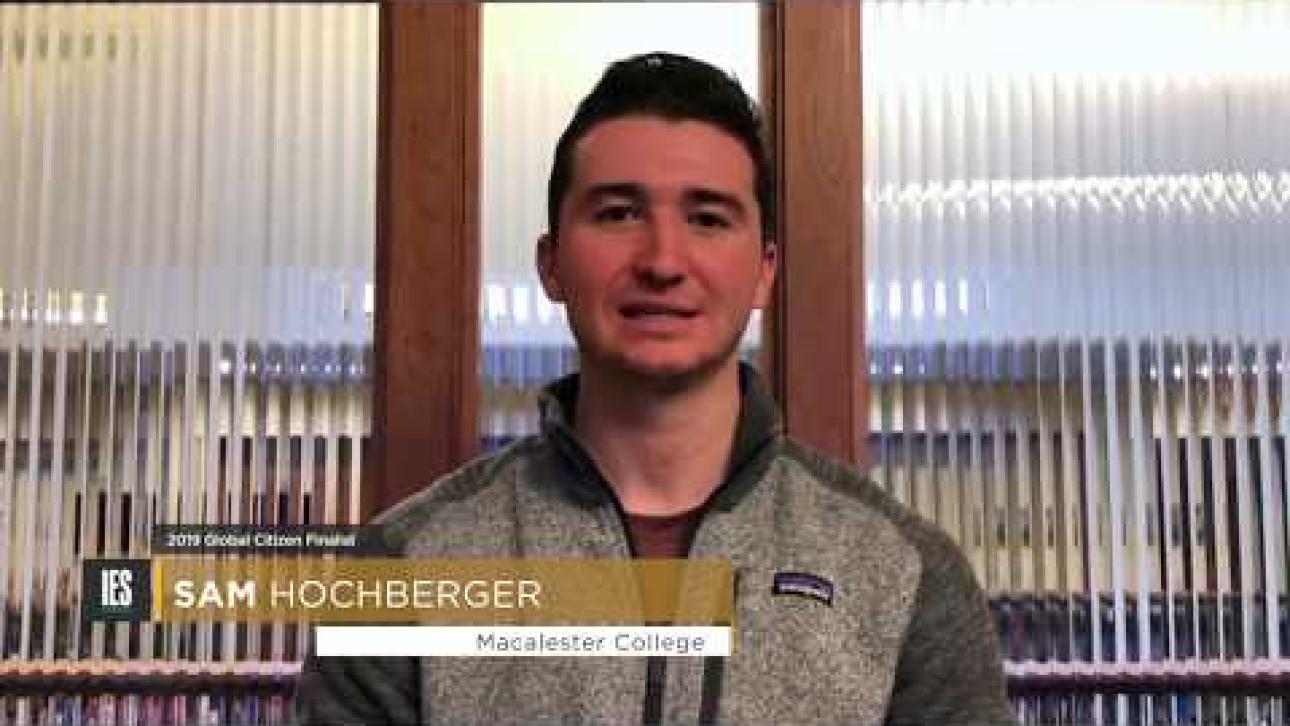
Sam Hochberger • Global Citizen of the Year Award

sam
Sam Hochberger
page_speaker

IES Abroad ProgramGranada - Study in Granada

College/University: Macalester College

Majors: Neuroscience with minors in Spanish and Psychology

Hometown: Maple Grove, Minnesota

Sam knew he would advance his knowledge of the Spanish language and culture while studying abroad, but he did not expect to come home with a new outlook on life, the world, and a new career path. After volunteering at a Granada non-profit that provides services to the autism community and their families, and having eye-opening conversations with African immigrants while on a field trip to Morocco, Sam made the decision to support immigrant and under-privileged communities back home in Minnesota.

“It should not be the job of oppressed groups of people to fight the battle of ending inequality alone,” he wrote. Sam now volunteers with Wellstone Elementary, a Spanish and English immersion school in St. Paul. He plans to teach English in South America after graduating to further develop his intercultural understanding before continuing on to medical school. In the future, he hopes to be a pediatric doctor working with low-income and immigrant Latinx communities to ensure underrepresented groups receive the high quality medical care they deserve.

Global Citizen of the Year Award • 2019 Finalist

Sam's Story

IES Abroad: Take us back to the beginning of your study abroad experience. What made you want to study abroad? Why Granada? How did your journey begin?

Sam Hochberger (SH): There's actually a couple of reasons that I ended up Granada. I did a couple of service trips while I was in high school to Costa Rica and South Africa, and kind of having those week-long experiences of being abroad kind of gave me that bug to want to go and actually want to have a meaningful long-term experience in a different country.

I had been studying Spanish for about six years, so I knew I wanted to go to a Spanish-speaking country, so that narrowed it down a little bit for me. And Europe was something I never experience before. I had been to Central America, so Spain seemed like the best option, kind of following out that way.

I wanted to be able to practice and work on my Spanish as much as possible, so I knew I wanted a smaller city where tourism was a little bit less, and so of the Macalester-approved programs, Granada was my best option I thought.

In addition to that, I was really intrigued by Andalucía by their rich history with the Moors and the Jews and Christians and kind of all that mix of experiences there. I thought it would be an amazing place to go, not just for the language, but also for the cultural aspect. So I guess those combination of things landed me in Granada.

IES Abroad: You interned with MÍRAME, a non-profit in Granada that provides services to the autistic community and their families. In your application, you wrote about an interaction that you’ll never forget. Can you share that story again and describe that experience?

SH: I worked with MÍRAME for two different programs. One of them was their adapted sports program, and that's where I met one little boy who was about five years old, and he had one of the more profound forms of autism that I worked with while I was in Spain. So he would do a lot of repetitive behaviors. He could make a couple of words, but not many, and really didn't have much interest in social interactions or concentration or anything like that.

Working with him was a challenge throughout the semester. He wouldn't really look at me or really want to interact with me too much. So I would just keep trying, really, every day, and without really any success with him. But one day, it was actually one of my last days with him, we were doing some sports activity and we had some balls out, and I just sat him down and I tried to have him push the ball back with me. I was speaking to him in Spanish because of course he spoke Spanish. And nothing was really happening.

I would push the ball to him and I'd have to go and get it and push it again. And I kept trying. I kept trying and saying, "Push the ball to me. Push the ball to me." And finally, he did. And it seems like the littlest thing, the smallest thing, like “who cares about it?” But after working with him for two months, and really, him not even really acknowledging I'm there, knowing that he heard me, he knew I was there, something got through to him in that moment, was really pretty amazing to me to see, given how severe his form of autism was.

So knowing that there is someone inside of him there that wanted to interact with me, that was a really, really special moment, probably the most special that I did in my internship.

IES Abroad: You previously had worked with children with developmental disabilities in the U.S. and you study neuroscience – two experiences that you said gave you tools and knowledge to utilize at MÍRAME. How did your previous experiences and studies inform your work at MÍRAME? 

SH: So yes, I am a neuroscience major, and I have had the opportunity to work with Gigi's Playhouse, which predominantly worked with kids with Down Syndrome but also kids with other disabilities here in the U.S.

And I would say over the course of the various psychology courses I've taken in school, we talked a lot about child development and some tools that people use to help work with kids and help them learn how to do things and hold their concentration. That really helped me from a kind of logistical sense of how I could interact with these kids with MÍRAME.

But I would definitely say my experience with Gigi's Playhouse was even more important to me given that I had already worked with a population that had intellectual disabilities. And it is different working with children with intellectual disabilities than typical children because there's different techniques that I had to employ to get their attention.

If there was an emotional outburst, there was things I had learned in the past that I could kind of draw upon the calm down situations especially emotionally charged situations and get kids to kind of refocus and try to integrate into group sessions.

I think the biggest thing those previous experiences gave me was the comfort in knowing that I could manage maybe uncomfortable situations while working with MÍRAME and that really helped me when I was there.

IES Abroad: How did your internship expand on your previous understanding of autism?

SH: This is actually one of my favorite questions because I wasn't expecting actually to have that different of experience working with kids who have autism in Spain than in the U.S. And I was very wrong because over the course of the semester working with the kids, focusing on just them, the presentation they had of autism it seemed different to me.

In my experience working in the U.S., kids are very reserved. They don't want to have any social interaction. They don't like being touched. And they definitely don't like interacting with each other very much. And I could see some of those things with the kids I worked with in Spain. However, I think Spain itself has a huge cultural importance on community, on connection, and they are a more tactile culture.

They do touching and hugging and kissing more than the United States from what I noticed. And that really showed in the kids which was very interesting to see. I would get kisses on both cheeks from some of the kids. They would hug me. They would try to interact with me, but they just didn't really know how. I think that's kind of how the autism was manifesting itself in those kids, was they didn't know how to do social interactions that most people can do, but they had more of a desire to have them then I think a lot of the kids in the U.S. that I saw.

And obviously, I don't know why that was the case with the 15 kids I worked with, but I do think there was a large cultural aspect that Spain on had on the development of those kids.

The manner in which I got to work with the kids in Spain was different than in the U.S. It was a different sense of a professional setting in Spain where I could have more freedom with the kids. There wasn't so many limitations. It was more unstructured, and I could kind of work with the kids based on their own personality, how they work best, and kind of formulate my own kind of action plan of how to best help them.

So it was a little more of a hands-off approach over there than it was here in the U.S., and I think there were advantages and disadvantages to that, but it was definitely a different style of working with them that was really interesting to be a part of.

IES Abroad: In your application you also shared about meeting with immigrants from the Ivory Coast in Morocco. What stuck with you from that conversation and how does it shape the way you see the world now?

SH: That was a very, very tough conversation to be a part of, especially coming from a very privileged background, being a white male living here in the United States. I would say before I had this experience, I knew about the challenges that people had immigrating from different places and you'd hear about it in the news, you'd learn about it in school. But it's a completely different experience learning a story from someone firsthand of sexual abuse, of being sold, or being betrayed by their own family or their own government, and just feeling like an outsider wherever they are.

It struck a chord with me, and I think, with every student that was in the room with me learning and talking that day. And it definitely pushed me to want to make a difference and do something for the immigrant population that live, where I live here in the U.S.

That was kind of the turning point for me of my abroad experience where I was. I knew I loved working with kids, I loved working with MÍRAME but I also wanted to now bring that to help an underserved population here in the U.S.

And so from that experience, that's what pushed me to want to volunteer in a Spanish immersion school this semester with low-income kids who are immigrants from Central America and South America. It's kind of lit a fire in me that something needs to be done for this population, and the people who are the targets of this racism in this difficult immigration process shouldn't be the only voice fighting for their rights.

I think the people who have privilege and privileged statuses in the world should be on the front lines with them to help and whatever small part I can do in that process I want to be a part of. So I think that is the biggest thing I took away from that conversation.

IES Abroad: What did you learn about the world through your experiences in Granada?

SH: I love this question, but I also hate this question because there was so many that I learned. But when I really break it down to just, I guess, the biggest theme that my semester was abroad in Granada that I learned about the world is that people live their lives in such a different way in so many different places.

I had a big culture shock going to Grenada and learning all the new customs and ways of life – and language apart from the whole thing – just how they behave, how [various] things are done over there is so different.

I think a lot of the political climate and culture that we live in today focuses on how our differences make us bad, or undesirable, or divide us. But what I really notice from being abroad was how welcomed I felt from the community over there even though almost everything I did and acted like was different from the Granadians that I interacted with.

Having that opportunity to work alongside Spaniards in MÍRAME and live with a host family, I was able to learn their way of life. They were curious and interested to know how I live mine. And I think that intercultural exchange that I had with them over there made us both better because of our differences.

So I think I really got to learn firsthand how our differences really make us a stronger world than a weaker one. And I think that message has gotten a little bit mixed up in recent years. So I think that's the biggest thing I learned about the world being abroad last semester.

IES Abroad: What did you learn about yourself?

SH: The biggest thing I learned about myself - and I think my friends and family would say I'm a different for it now that I'm home - is I realize how important people are in my life. I know before going abroad, it was very, very academic-based. And I love science. I wanted to be a scientist. And just that was it. And I valued my relationships, but not like I do now.

Being abroad, especially in Granada specifically, there's such a strong sense of community. There's such a strong sense of love for your friends and your family and your neighborhoods. And I was constantly being waved at on the street or hugged by someone I just met. And there was so much just love for other people that I saw there.

… And it actually really strongly influenced my decision to want to become a doctor rather than a scientist because I want to have that interpersonal relationships with patients, with people, with my job one day. I think working and living with people is the most important thing.

The culture and environment that lives in Granada really exemplified that for me and made me really think a lot harder about how important my relationships are with everyone that I love.

IES Abroad: How has your study abroad experience shaped your future? What’s next for you in the short-term? What kind of world do you want to help build in the long-term?

SH: The short term is that I'm in my third year of college, and I have about a year and a half left. With that year and a half, I am working at a-- as I said previously, a Spanish immersion school. And so I really am going to try to use this next year to really involve myself with the Latinx community here in the Twin Cities in Minnesota because I realize that that is the population that I want to serve one day as a doctor predominantly.

After college, I hope to travel abroad actually to South America to work and teach English in a South American country to hopefully achieve fluency in Spanish but also to really learn about the culture and the places that Latin American immigrants come from.

Then I'll hopefully one day be able to go to medical school and work to have a focus on pediatric, working with children and especially children that are Latin American immigrants maybe that are from a lower-income community.

A lot of that has to really with what I experienced in Morocco and with MÍRAME and what I did abroad last semester. So my paths have changed before, but as of right now, that is really what I'm looking forward to do, and I have a lot motivation to do it.

IES Abroad: Thinking about yourself and your peers who will be graduating in the next year or so, what do you think are some of the biggest challenges you anticipate facing?

SH: The biggest challenge I anticipate facing is the complete independence that I'll have after I'm done with college. I think a lot of people think that after high school you can go and do whatever you want to do, and that is true but if you choose college, there is quite a bit of structure to that.

When I’m done, it's kind of all on me to make my life what I want it to be. And so that I think will be a little bit of a challenge to make a structure for myself for once. And I know I've heard the same thing from several friends.

That is one thing I am also grateful for going abroad as well because that definitely being thrown into a country by myself without a ton of support-- a lot of support coming from IES Abroad, but other than that, not a ton-- really helped me, I think, being able to envision myself as being an independent, functioning adult after I'm done with college.

So I think that independence, that sheer independence will be probably the biggest challenge.

IES Abroad: What do you think are the most important skills and qualities you will all need to carry with you to face these challenges?

SH: I think probably the biggest skill that I'll need and my peers will need is an open mind.

I was talked to a lot about having open mind in my pre-orientation process before going to Spain, and I thought about that really ever since – going into every situation now with an open mind about how different people think, in different ways, and how I'll have to be able to adapt myself to different situations. I'm not always going to get along with everyone and not everything's going to work out.

I think going into especially challenging situations, like a new job or a new career, to have an open mind and that everything is possible will really make that experience easier, rather than trying to brace for the worst, or I already think I know what's happening when I really don't.

So I think definitely having an open mind will be the biggest key to success after college, for me and my peers.

IES Abroad: Who is a peer that inspires you; whether that’s someone you know personally or have looked up to from afar?

SH: The peer that inspires me and actually inspired me to go abroad was my best friend from home. She has been, I think, my friend for six years now. And she studied for six months in Australia in 2019 as well, at the beginning part of it.

She was the first person I knew to study abroad that was my age, and she did not have one ounce of fear going into it. She was so ready. She planned everything out. She was so independent about the whole thing and lived that experience in Australia to the fullest she possibly could.

Hearing about her experience and what she did down there and what she learned and how she was different coming back, really inspired me to want to be a global citizen, to want to go abroad, to want to see and live in a different culture. That has fundamentally changed who I am. I strongly believe so. I think she has been one of my biggest inspirations over the past couple of years in that sense of independence, and really wanting to do something with your life and go abroad and see how different the world can be and how different people can be in different places.

IES Abroad: If you could give one piece of advice to future study abroad students, what would it be?

SH: I would say the same piece of advice that my program director in Granada gave me the first day when we arrived in Malaga, which is – I think a lot of people think when you go abroad, you need to go to a different country every weekend. You need to explore and see every city in the country you're in. And while those things, I do believe, are important - I think it is very enlightening and a cool experience to see different places while you're in a foreign country - to me, it's much more valuable of an experience to immerse yourself in the city that you're studying in.

I think that's what I really tried to do while I was in Spain. And because of that, I was able to meet so many Spaniards. I was able to see the culture and their life in Granada in ways that I think maybe not everybody in my program was able to. I had time to take a dance class. I had time to intern at MÍRAME, to take a class at university, and really feel like part of the Granadian culture by the time I was done there. Whereas if I went to 14 countries over the course of the semester, I don't think I would have been able to say that same thing.

I think we have our whole life to go to other countries for a short period of time, but most of us won't have the opportunity to live for, in my case, four months in one place outside of the United States. And to really be able to commit yourself fully to being an international student of that culture, can impact you a lot more than just trying to travel everywhere in that one semester.

So if there was one piece of advice I could give, I would say do your best to immerse yourself in the place that you're studying in, and that means knowing the people of that culture and what that's all about there.

“The culture and environment that lives in Granada ... made me really think a lot harder about how important my relationships are with everyone that I love.”

Sam H. • Macalester College • Granada - Study in Granada

Sam Hochberger | 2019 Global Citizen of the Year Finalist
Maple Grove, Minnesota

Interning Abroad the Italian Way

Hi everyone! 

I hope you are all safe, happy, and healthy.

I have been in Rome for over two months now. I have been having the time of my life exploring the eternal city, and I have also been having a lot of fun working a full-time internship. I am lucky enough to be interning for Il Romanista. I get to help produce media for AS Roma, one of Rome’s soccer teams. Rome has two teams, Lazio and AS Roma, but I’d argue AS Roma is the better of the two! In general, there are about three times as many AS Roma fans as there are Lazio fans in Rome.