
For one of the IES Abroad Tokyo field trips, we went to Sawara over the weekend for their famous annual matsuri celebrations. This is what the one-day IES Abroad field trip looked like:
Traveling to Sawara
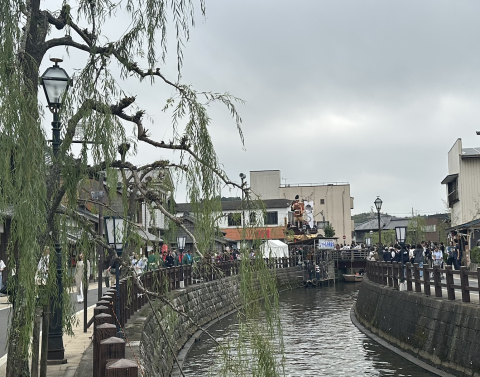
Located further north of Chiba Prefecture from the dorm, some of us took the two hour train then transferred to the Narita Line to get to Sawara. After just two hours on the train, past all of those rolling hills after quickly exiting the urban areas, we reached Sawara. As a small group, we walked along the town where all the matsuri stalls were already open and you could already hear the music playing from a distance.
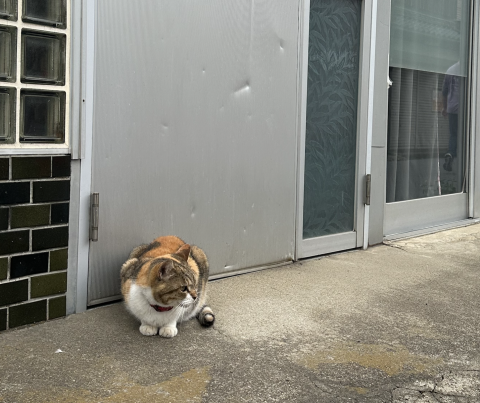
Because it’s a village more in the countryside, there was not a skyscraper in sight, and some blocks of Sawara had Edo-styled buildings that were really pretty to walk past, with several stray cats lurking the area.
Cultural Learning
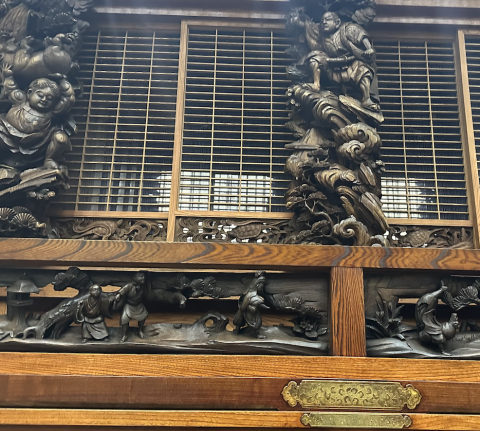
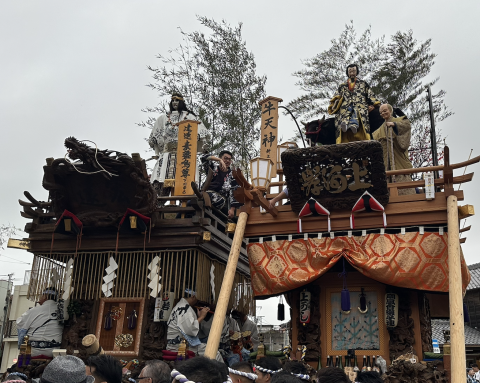
Our first activity was going to a museum situated in a temple to learn about the matsuri festivities in Sawara. The museum gave us context for the celebration we were about to see, as well ass other festivals that happen all across Japan over the different seasons. Celebrating past historic and war heroes and figures in mythology, each matsuri float at the Sawara Festival is as tall as a two-story house has its own representative statue.
When we exited back out onto the streets, it only took walking two more blocks to hit the crowds that were at stalls and waiting for the floats to pass by. Multiple floats go on different respective paths throughout the town, and are pulled by at least thirty people including children at the very front. The people seated in the float play music, and the tunes are unique to each respective float.
Cultural Activity
After watching a few floats getting pulled by, we were told we were going to get a chance to pull one of them too. One of the IES Abroad staff members was friends with the people involved with the float, and they were kind enough to let all nearly twenty of us join in pulling the ropes, chanting rhythmically as we hauled in unison. I joined a small area by the rope and began chanting and pulling with everyone (definitely an unexpected workout.) Every now and then, loud, wooden blocks clapped, and we’d have to drop the rope and start a fan dance to show gratitude towards the community after receiving a donation.
The whole pulling of the float was a whole community effort, from the people at the top of the float pushing away branches that were in the way, the men at the very back pushing and the front pulling the levers by the wheels, to all the people pulling the ropes. We ended up pulling the float over two blocks and around and across the river.
And even though we were clearly foreigners in this more rural part of Japan, everyone welcomed and celebrated with us. Many of us stopped to talk to the other people involved with our float, and I got to make friends with people who also happened to be students at Kanda University.
Overall, it was a really unique experience I couldn’t imagine being able to do before, and thanks to the IES Abroad staff who arranged everything, has connected my classmates and I to the community in ways that not many foreigners get to do in Japan. This wasn’t the only IES Abroad field trip I’ve been on so far this semester, but it was a definitely memorable one and a great way to bond with people from the program, IES Abroad staff, and of course, the locals.
More Blogs From This Author


Life After Coming Back from Japan
Reflections on my semester abroad and dealing with *dun dun dun* the Japan withdrawals.


Gracelynn Lu
I'm Gracelynn (she/they), a clinical psychology and women, gender, and sexuality major at Tufts University! I like writing, playing the cello, K-Pop dancing, anime, making tea, cosplay, crafting, and watching Asian dramas.

