This past semester I had the opportunity of being a direct exchange student at “the Harvard of Africa” aka the University of Cape Town (UCT). As an exchange student, I felt that I was suddenly a confused freshman all over again. I definitely learned a lot about myself as a student, and my ability to adapt to an entirely new school culture. I remember wishing I had access to more information, so that my transition could’ve been smoother. That feeling is why I am writing this blog.
ACADEMIC CALENDAR
The first difference as a student at UCT is the academic calendar. The “fall semester” begins mid-February and ends at the end of May. The “spring semester” begins end of July and ends in November. Unlike my home University, the finals period is not just a week, but it is an entire month. So for the “fall semester” the exam period is June, and for “spring” it is November. This was very interesting because you could end all of your classes May 24th, and have your only final on June 23rd. That is almost a month gap, which means you have to do your best to continue studying even with school finished.
COURSES
Before you even reach South Africa, you will go through the class selection process. The IES Abroad Guidebook gives instructions on how to choose classes, and the whole process of getting them approved. Make sure that you pay attention to whether or not the courses you are taking have final exams, and the weight of those exams. This way you are not surprised to see a course has a 40% final exam.
One of the things my peers and I wish we did, was have back up classes on standby, in case we were not approved, or wanted to drop a course. Unfortunately, we had a very limited time period to drop courses, so that meant we would need to know whether or not we wanted to stay in a lecture after only attending a couple of times! This felt very sudden, but if you talk with other people about the courses they are in, you can get ideas on what to take.
Luckily, all of the courses I selected were approved, and I only had to drop one course. Which was a process more tedious than I expected. It was not just the clicking of a button. There was a form that needed to be signed to both add and/or drop a course, and approval that needed to be granted in addition to filling out the form when adding a course. If you end up having to go through these processes, do not worry because a lot of people are in the same boat, and you can always ask the IES Abroad academic advisor Devonne for help.
LECTURES & TUTORIALS
I came from a large school, so adapting to the student body of over 29,000 students at UCT was not too difficult. However, some of my friends in the IES Abroad program, that came from smaller schools found it to be slightly intimidating. Because of the large student body, lectures could hold up to 100+ students. The size of these lectures also made it hard to reach some professors. Which is when tutorials come into play. Most lectures whether large or small have another section you are required to take called a “tutorial” or a “tut”. My home university referred to these smaller classes as “discussions”. In these tuts, you will have a tutorial leader/tutor who helps break down lecture material, and they are usually the ones in charge of grading your papers. Participation and attendance in these tuts is essential to boosting your grade. Also, if you manage your time well, your tut leader may be willing to give feedback on some of your work before submitting.
A culture shock for me while attending UCT was the rotating of professors. In some of my courses, I had a different lecturer every week, for five weeks. Other courses had a couple of consistent lecturers who swapped back and forth and then an occasional guest lecturer. This meant that I would have to adapt to different styles of teaching. You can find this information in the syllabus, so make sure you are aware of the changes. In addition to rotating professors, tut locations would also switch halfway through the semester. Amathuba is the learning platform that is used for all of your classes. Important announcements are usually posted here, so make sure you are consistently checking it that way you don’t end up in the wrong building. And if you are struggling to find a building, you can look up the UCT map, and find a building.
GRADING & PLAGIARISM
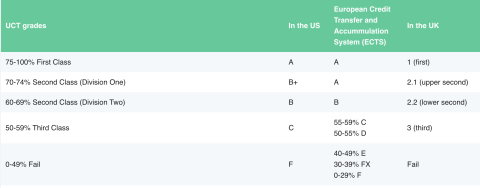
While your tut leaders do a lot of the grading, they are not the final examiners. The course convenor is the one who gets the final say on your grade. Usually, the course convenors generally agree with the tut leaders, and might mark you up or down a couple points. This brings me to my next point which is the grading scale. If you are someone who is used to getting straight A’s....it is best that you adjust your expectations :). We were warned that they were more skeptical when grading, and that it might be difficult getting A's. I did my best to note all the expectations and comments from previous assignments, and would still sometimes not get my desired grade. While this could be discouraging at times, I did my best to take the feedback I received and apply it to upcoming assignments.
Something to note when submitting assignments is the plagiarism declaration. This is a form required by all courses that you must fill out stating that the work you are submitting is your own. Plagiarism is taken very seriously, and failure to submit this form could result in grade deductions or your assignment not being marked. Different courses have different ones. This information can be found in the syllabus. Other study abroad students compared this form to the declaration statement they would have to write at the end of their assignments. I never had to do this so this was very new to me.
STUDENT CULTURE
One thing I found really assuring was the culture amongst students. Every lecture had a WhatsApp group chat. This is where people ask general questions about assignments and anything class related. In this chat you will find the class representative. The class rep is voted for by the class in the first couple of weeks. Their role is to express the needs of the students with the lecturers. The students are very vocal at UCT. So if the class feels a deadline is too close they typically will rally support from students and have the rep ask for an extension. Professors are usually perceptive to students and grant these extensions.
Not only did classmates advocate for one another, but they were very friendly. A way that I made friends outside of class was by eating lunch outside on the steps near Sara Baartman Hall. When the weather was nice people would congregate outside and hang out. The best time to meet people was during meridian (12 P.M. in the afternoon). On Thursdays the campus held "Plaza Thursdays". Plaza Thursdays consisted of various vendors that would sometimes give free items . The energy drink brand "Monster" literally sponsored a motorcycle show in the middle of campus where they did various tricks, and free monster was handed out. Another time a hygiene brand "Playboy" sponsored a dance battle for students and faculty on campus for a cash prize, while handing out free items. Alongside big vendors, clubs could promote events and would have speakers playing music, and smaller vendors would sell food or treats. During these times, there were even more students outside of Sara Baartman.
Another method of making friends was through joining clubs and sports teams. I was a part of kickboxing for some time, and people were so welcoming and made me feel comfortable trying a new sport. This welcoming community was even present during sports events. Rugby games were always filled with great energy. People danced, sang, cheered and you truly felt like you were a part of the school.

TAKEAWAYS
During my time as a UCT student, I truly learned the importance of work-life balance. It can be easy to get caught up on exploring Cape Town and forget about the STUDY in Study Abroad. I can admit that at times I was more focused on hanging out with friends than doing my readings for the week. I wanted to make the most of my time in Cape Town, since I allowed school to consume me back at my home university. However, there is a healthy balance, and I found it for myself as the semester progressed. Another lesson I learned was to "never get too comfortable". While the systems at UCT differed from my home university greatly, I was able to appreciate in the end how being put out of my comfort zone allowed me to flourish as a student. I have become a more critical thinker and learner while at University of Cape Town. I hope this blog gives you some insight into life as an exchange student at UCT.


More Blogs From This Author


Cape Town Chronicles: Trip to Johannesburg/ 5 Things to Do in Jozi
In this blog, I compare my time in Johannesburg to Cape Town, and give 5 activities you can do there.



Cynthia Njenga
I am a Kenyan- American from Massachusetts. My pronouns are she/her. I am a junior and a first-generation student at Boston University studying Behavior and Health. I am attending the University of Capetown this Spring semester.