About 100 miles east of Naples, in the province of Avellino, perched on a little mountain above the Ofanto river, is the town of Calitri. It is somewhat notable for being the site of a battle between the Americans and Germans during the Second World War, as well as the birthplace of Angelo Maria Maffucci, a pathologist who discovered a disease that affects your hands. In my family, it is known as the town where my great-grandfather, Christopher Maffucci, lived over one hundred years ago, before decamping to New York City on an ocean liner.
I visited Calitri once when I was little with my family, and I remember a good amount from then. The town was very small, quiet, a little forlorn, still not recovered from a devastating earthquake in 1980. I remember meeting a few distant relatives, including some Americans from New York who had moved back to the town to retire. By far my greatest impression was the abundance of signs bearing my last name, or rather that of Angelo Maria, Calitri’s famous pathologist. Probably a third of the businesses in the town were some variation of “Maffucci,” there were two Vie Maffucci, a commemorative gate and a plaque, and numerous entries on the town’s war memorial. The family house sat abandoned on the edge of a cliff, existing as it had when my great-grandfather had left. I was fascinated by this as a young boy.
I don’t have much connection to the town, of course, because my family left so long ago. But I have always wanted to return. Last year, I was tending bar in America, and a man happened in whose father was from the next town over in Avellino. We got to talking and he left me a bunch of money because, in his words, he “would always take care of another Avellinese.” This coincidence reminded me of my wish to return to Calitri and in part convinced me to study abroad in Italy.
I got to Calitri in May, a few weeks after the IES Abroad Rome program ended. Calitri is about as far from all convenient transportation as possible, so my journey consisted of several legs between Naples and Avellino. I asked a guy in Naples where I might find the bus for Avellino, and he told me, but added: “I must ask, why on earth would you go to Avellino?”
The bus to Calitri was actually just a sprinter van, which seemed to double as the school bus for the local children. The school kids could tell I was from far away, I suppose, because they heckled me with “Ciao biondo,” and “Justin Bieber!” the whole way to Calitri. We rolled off into the hills of Avellino, which were startlingly beautiful, and lush, from the rainy spring. The bus dropped me off halfway up the hill, so I had a decent climb up to the apartment I rented in the centro storico of Calitri. One of the benefits of visiting such a remote area is that everything is cheap, so I got the whole apartment for like 30 euros.
I walked around the town, which is still partially abandoned from the earthquake. There were a lot of cave-houses tucked into the hillside, some closed off, and some open for exploration For some inexplicable reason, someone had left a taxidermy bobcat in one of the houses, which scared the [expletive deleted] out of me. It looked really real.
The town looked to be doing a little better than I remembered. There were some stores open, mostly butcher shops and fruit sellers, as well as a few bars and clothing stores. There were a few young people and families hanging around in the main square, and the church seemed to be well maintained. There several a few construction sights and urban renewal projects underway, including one that, unfortunately, had included the recent demolition of my great-grandfather’s house.
I bought some strawberries for a euro and sat on the edge of one of the town’s cliffs, eating them and smoking and watching the sun come down on the valley. There were a few stray dogs wandering around the town like I was, but they were friendly and didn’t seem to be bothering anyone. Eventually I decided to go to see a woman, one of my distant relatives, who I remembered from last time had owned a chicken store near the main square. I said hello to her and told her I wanted to say thank you for showing my family around the first time we had visited. She was very nice and asked me how everyone was doing in the United States. I bought some biscotti from her to take back to my family.
I went to the only restaurant open that night, which was of course amazing and super cheap and surprisingly busy. I realized that I was probably one of the only guys my age in the town with (sort of) blond hair. No wonder I was “biondo” to the kids on the bus! I talked a little with the owner, who said he knew some of my relatives in the United States and that he had been to New York, New Orleans, and Colorado. His name was “Gioseph,” and not Giuseppe because his father had lived in New York and then returned to Calitri and given his son an English (sort of) name in memory.
I fell asleep that night in Calitri, the first in my family line to do so in many many years.
I hope this encourages other IES Abroad students, in Italy and everywhere else, to visit the places of their roots. Most everyone in America has a relative or relatives from somewhere else, and I believe it’s important to remember your ancestors, and where you come from, both literally and figuratively. I think this sentiment is growing more common in our generation. I know a good number of Americans my age who are interested in learning more about their family history, and this may be the one of the most positive developments in recent years. Maybe it’s because we are less certain in the future of our country, maybe it is just a greater appreciation of the quintessential American immigrant experience.
People, at least in Italy, are usually intrigued to know that they have distant relatives living in America, or will at least pretend to be with typical Italian warmth. Many strangers in Rome would ask about my last name, although I don’t think anyone knew Angelo Maria Maffucci and his work as a pathologist. It’s very sweet to see the distant bond that our two countries still have, and it “roots tourism” has been a great economic boon for out-of-the way towns like Calitri. Towns that yielded a lot of migrants will often have resources in the municipal office for you to learn more about your family history.
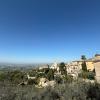
The next day was the market day, which brought an air of festivity to the otherwise quiet town. Even the stray dogs seemed to participate in the festivity, chasing cars and barking. A fruit guy gave me a nectarine, and I ate it and waited for the bus, which was again full of school children. I said good bye to Calitri, which looked especially beautiful in the distance, its’ multicolored houses and apartment buildings shimmering in the midday sun.
Buon viaggio,
Chris





Chris Maffucci-Fitanides
I am a student from Philadelphia, USA, studying History and Classics. I love to write, draw, cook, eat, play guitar and make films. I hold the record for fastest time to eat a fried alligator po-boy in a small restaurant in Lafayette, Louisiana.