

Last weekend, I went with an IES Abroad Vienna group to the famed city of Salzburg, known for being Mozart’s birthplace and being featured in The Sound of Music. My thinking behind signing up for this trip was fairly straightforward: I don’t like planning travel, and signing up for this trip (for an added fee) would mean that I wouldn’t have to worry about booking transportation or accommodations, and that a handful of activities would be pre-planned. In that regard, this trip was absolutely worth it, and I recommend IES Abroad excursions to other reluctant travelers.
Friday
Our journey started at 8 A.M. on Friday, when we all showed up at the Hütteldorf bus station for our long ride to Salzburg. It was pouring rain, so our massive group huddled near the exit and blocked passersby from exiting.
The first thing we did was ride the bus to Hallstatt, an intermediary stop in the mountains. It was about a three-hour bus ride and I slept for most of it, but I woke up in time to catch some of the gorgeous views of Lake Hallstatt. As we approached the parking lot, one of our chaperones got on the microphone and gave us a pep talk of sorts:
“Hallstatt is very small, with a population of about 800, but it’s gotten a huge boom in tourism in recent years. It’s been called ‘the most Instagrammable town’ for its insane views. However, the locals don’t love the tourists, especially the daytrippers who come in, take photos, and don’t contribute anything. Do we fall into this group? Maybe.” We all laughed and looked around awkwardly. She continued, “If you guys want to buy lunch and contribute to the economy, that would be much appreciated. And please be respectful.”
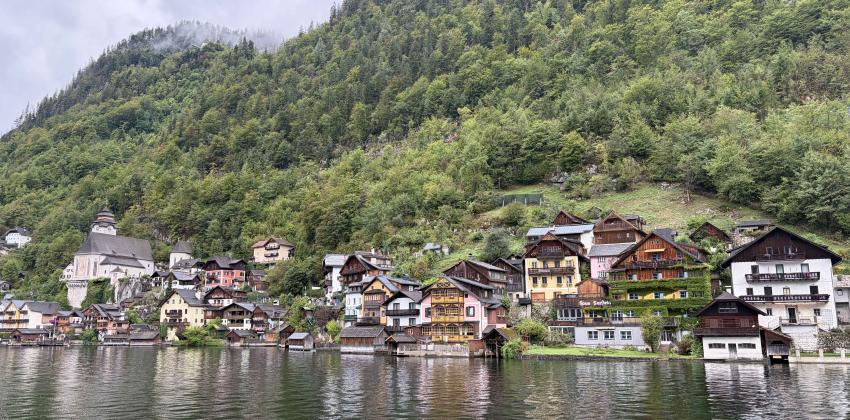
When we got off the bus, I quickly saw what she meant. There were tourists everywhere, and perhaps even more numerous were the souvenir shops selling AI bumper stickers saying “I Instagrammed the most Instagrammable town” or whatever. All the bathrooms had barriers requiring you to pay one Euro to enter, and even the swans seemed to expect food.
Despite all of that, the town was undeniably beautiful. During our boat ride, we could see the magnificent mountains peeking out of the fog. It was very cold, so I recommend you bring a warmer jacket than I did.
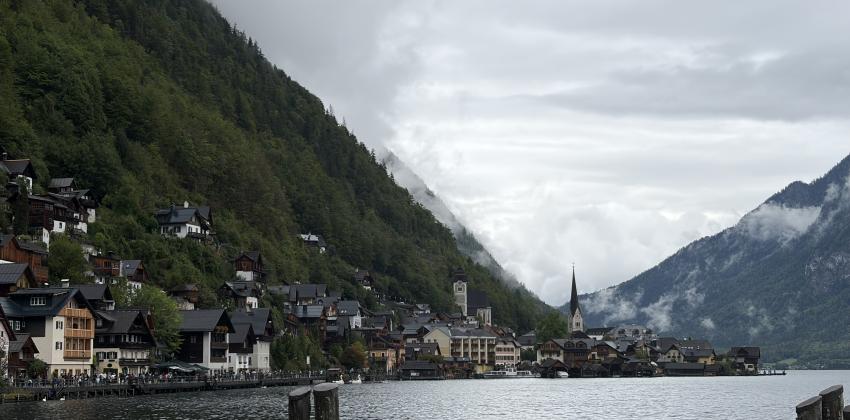
The thing that stood out to me about Hallstatt the most was not its natural beauty, but the adversarial relationship between the town and its tourists. For example, there were tons of private houses with “no photos” signs that many tourists ignored. It was also difficult to find reasonably priced vegetarian food. We ended up buying snacks at a grocery store and then wandered the town looking for a place to sit. Eventually we found a bench outside a museum and ate across from another group of tourists doing the same thing. It wasn’t awful or anything, but it certainly wasn’t the most Instagrammable moment.
To be clear, I don’t blame the locals for our subpar experience—their resentment for tourists is very understandable given that the town blew up out of nowhere, causing a boom in visitors that they couldn’t accommodate. My biggest takeaway from Hallstatt was that when a place becomes too tourist-centric, it ironically becomes a worse experience for many tourists seeking an “authentic” experience. Are there tourists that just want to buy AI slop and eat a 20 Euro hamburger? Probably. However, there are also a lot of tourists that just want to soak in the views, see a new place, and experience a culture without disrupting the locals. I couldn't help but feel like by visiting Hallstatt, we were contributing to the erosion of the town.
Probably my favorite part of the town (and one of the least tourist-y) was the cemetery on a hill with ornate graves, and the ossuary. It cost a very reasonable two Euro to enter the ossuary, and inside was a single room with hundreds of painted skulls (a cultural tradition of the eastern Alps). As I stared at all the skulls, I found myself thinking of all the people who used to own them, now crowded in one room together as a tourist attraction. When me and my friends stepped back outside, we ended up having a lengthy conversation about mortality and what we wanted to happen to our remains. We all agreed that seeing people’s skulls—as opposed to gravestones—made them seem much more human.
At 4:30 P.M., we got back on the bus to Salzburg and soon arrived at our hotel, the Meininger. It was an upscale hostel where we were assigned rooming groups based on our preferences. We had the rest of the evening to ourselves, so me and a couple of friends ate at Pho Ha Noi, a restaurant right up the block. They had multiple pages of vegan and vegetarian options, and I had the vegan pho, which was incredible.
Saturday
I slept like a rock and woke up on Saturday ready to conquer Salzburg. We started with a continental breakfast downstairs, which was a little lacking in vegetarian options, but overall fine. The coffee machine made great cappuccinos. Then we took the bus downtown for our walking tour of Salzburg. Our guide was a lovely Austrian woman who wore a traditional dress and carried an umbrella. She showed us around the beautiful palace gardens as well as the old town, and we saw the outside of Mozarthaus. As we approached the latter, we heard a familiar song playing. Is that “Rewrite the Stars” from the 2017 hit musical period drama film The Greatest Showman? I wondered. And sure enough, it was. Once they were done, they started playing the theme from Christopher Nolan’s film Interstellar.
At first I thought the music was being piped directly from the Mozart house, but then I spotted the culprits: a pianist and cellist busking not fifty feet away. They were talented, but the fact that they insisted on playing not Mozart music but instead mediocre soundtracks to seduce the tourists there to see Mozart’s birthplace was both hilarious and a bit sad. When the tour was finished, we ate an included meal at Restaurant Sternbräu, in a beautiful courtyard. The waitstaff was pre-informed of our dietary restrictions, so I got tomato soup and spinach dumplings. We also had a delicious dessert of plum cake.
After lunch, we were turned loose in Salzburg. Because we all had Salzburg Cards included as part of the trip fee, we had free and reduced admission to a lot of popular attractions. My friends and I decided to go to DomQuartier first, which is a HUGE museum in Salzburg’s old town. I kept expecting each room to be the last one, but the chambers of art, religious lore, historical artifacts, and ornately painted ceilings just kept going. My friends and I ended up splitting up due to the vastly different paces at which we consume museums. Halfway through the museum, I walked through a door and found myself on a balcony overlooking a massive cathedral with no warning. I was absolutely blown away by the scale and beauty of the space.
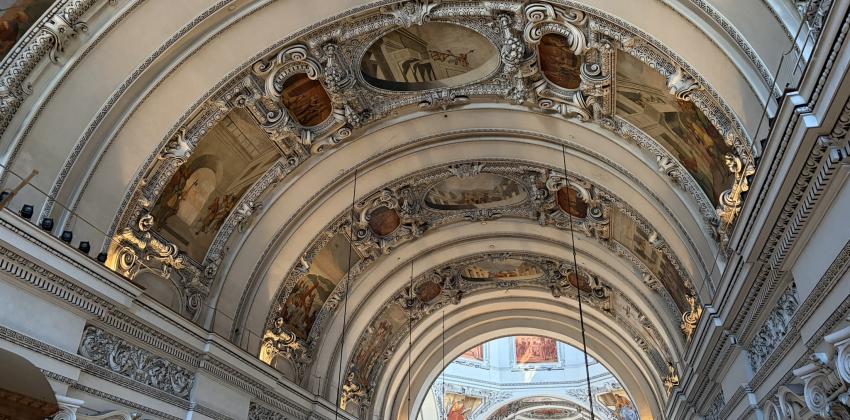
When I was done with the museum, I investigated the ground floor of the cathedral (it’s just called the Salzburg Cathedral), which was equally breathtaking. I then wound my way through the Red Bull bike race that was occurring to the Festungsbahn, a funicular railway which takes guests up and down from the fortress. The fortress loomed over us the whole time we explored Salzburg, and it looked so imposing that I just had to explore it. I would say the actual fortress itself was a bit underwhelming, but the diagonal ride up the mountain and the views from the top were absolutely worth it. This is another example of the Salzburg Card coming in clutch, as the funicular was 100% free.
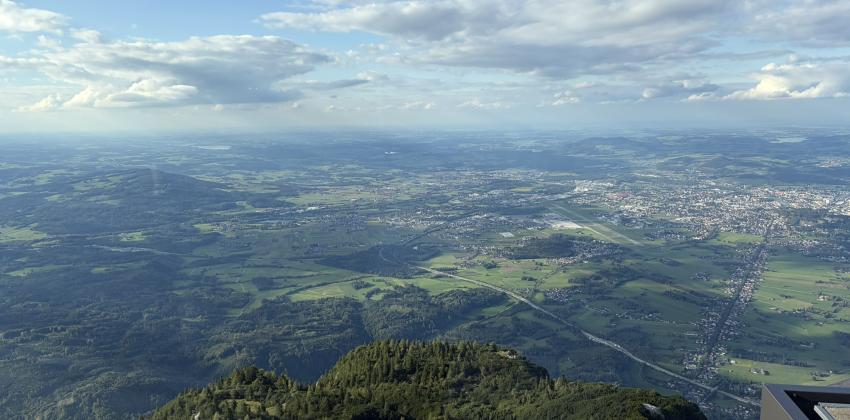
After the fortress, my friend and I took the bus across the city to another mountainside adventure, the Untersbergbahn. This gondola’s claim to fame is that it takes you up 1,776 meters in eight minutes. I didn’t really have a frame of reference for how high that was, so when me and my friend showed up a few minutes before closing and hopped on the gondola, we had no idea just how insane the ride would be. In just a few minutes, my ears were popping from the height as we watched the city spread out below us. I ran from side to side in the gondola, peering out the glass walls at the houses, fields, and hills below. When we disembarked from the gondola, we could take in the view even more completely from the ridge. There was a cafe where people presumably hung out during the day (we were too late to find out), and plenty of places to sit and gaze at the view. On the trail that led away from the gondola station, there were no barriers between us and the 1,800 meter drop. It was, hands-down, one of the most amazing views I’ve ever seen.
After coming down, we were both exhausted and our phones were about to die, so we went back to the hotel to recharge literally and metaphorically. Later, I met my other friends at an Indian restaurant called Taj Mahal. While it was in fact not the actual Taj Mahal, the food was delicious, and it was cool to see a menu written in three languages.
Sunday
On Sunday, we had breakfast in the hotel again and put our luggage on the bus so we weren’t burdened with it. We had some more free time in the morning to get the most of the Salzburg Card, so me and my friend decided to go to the Folklore Museum. We had heard from other IES Abroad-ers that it was up a steep hill, and they weren’t joking—we were both panting by the time we reached the top. However, there were more magnificent views as a reward. If there’s one thing Salzburg nails, it’s the views.
The museum itself was cute, though quite small. I would say it’s worth checking out if you’re especially interested in the folklore side of Austrian culture, or if you’re going to the nearby zoo, but there are probably bigger and better museums out there. That said, there were some very cool clothing items on display, including some ten-foot tall hats.
After we ate lunch at a cafe and met up with the group again, we took our charter bus to Salzwelten Salzburg, a nearby salt mine. When I heard that we were doing a 90-minute tour of the mine, I was a bit skeptical; I imagined we would be trudging around in a dank cave with a tour guide droning about different types of salt. I couldn’t have been more wrong. Well, okay, we did learn about different types of salt, but the experience was far from boring.
We started by putting loaner jackets and pants, to protect us from the mud and the cold. We looked like a strange group of prisoners, all headed into the salt mine in our identical white uniforms. Then we got on a “train” which was more like a motorized wooden beam that we all straddled, while holding onto the person in front of us for dear life. The train ride itself was short and quite fun, down a dark tunnel into the center of the mine. I have to wonder if it was really necessary or if they just implemented it to add another layer of novelty.
Later in the tour, we came to a room with a wooden slide which we went down in pairs or trios. We all started whooping like a bunch of middle schoolers being told we were going to Six Flags. The slide was not incredibly fast, but it was thrilling, made more so by the fact that we didn’t have to sign a release of liability beforehand.
The most lacking area of the tour was the actual information. It was certainly melodramatic, between the Planet Earth-esque film we watched before entering and the dark shadows of miners projected on the walls as we rode a boat underground. If there’s one thing I learned from the tour, it’s that salt is very important to human society. What I don’t know is why. The information was presented through a reverse chronological framing, where we started in the present and progressed backwards, eventually ending up in prehistoric times. It was interesting, but I don’t think I retained a lot. That being said, our tour guide was fantastic—very enthusiastic about salt, and an expert slider.
When the tour was over (and it really flew by), we took the sketchy train back out into the daylight. We had about an hour to kill in the town before we departed for Vienna, most of which I spent lying on an adirondack chair overlooking the beautiful view. There was also a playground which many of us enjoyed, despite being above the intended age group—who doesn’t love a playground with a mountainous view?
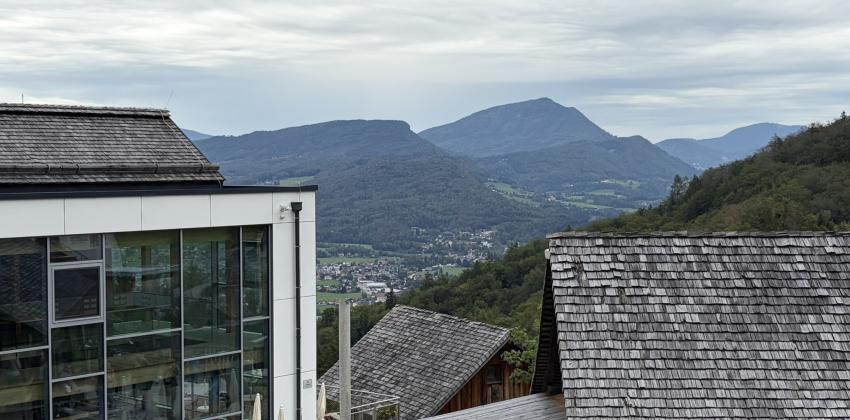
You might think my account of the trip would be over now, but I actually have one last anecdote to share. You see, since we were on the bus from 4 P.M. to 8 P.M., we had to stop for dinner somewhere. And where could we go that would feed a vast quantity of college students in a brief span of time? That’s right, McDonald’s. We pulled over at a gas station in the rain which was right next to one, and that was how my trip to Salzburg ended: sitting outside an Austrian McDonald’s in the middle of nowhere, eating gas station pretzels for dinner in the pouring rain.
More Blogs From This Author


Llamas, Lederhosen, and Long Slides: My Weekend in Styria
I had heard from an insider source that the one-night Styria trip is the IES Abroad staff’s favorite, so I was pretty excited.


Auden Svoboda
I am a writer, singer, and actor originally from the California Bay Area. In my spare time, I enjoy playing pickleball, reading science fiction, playing guitar, writing poetry, and drinking lattes. I am passionate about equality and justice for all. Free Palestine!

