For as long as I can remember, music has been my life. But music has been my life where my life was - in the United States. For the past two months, my life has been in Vienna, Austria. And it's an entirely different life. It's busier; bigger. It's also incredibly focused on my life of music making.
The opportunity to study music in its various forms in the City of Music is not one that's lost on me. I truly feel as though my time and my studies here are irreplaceable and extremely rewarding. But it was a big shift to begin my musical studies here as compared to my studies in the States, and at times I felt unprepared to manage this change. It wasn't until I reached out to a beloved teacher from my past that I was able to gain perspective, understanding, and a newfound appreciation for the new musical world I could now immerse myself in.
First and foremost, I consider myself a composer more than a violinist, but I've been learning the violin for over ten years now. For the past two years, I've also found myself happily indulged in the realm of music research. Here I have been in three worlds - the world of practice and performance, the world of dissecting and understanding, and the world of creating something new entirely. While I love to write pieces for myself to perform and understanding the history of the music that came before me, and aiming for the mastery of an instrument is often vital for development and understanding of musical ideas, themes, and progressions, these three worlds of mine have been largely separate. Practice and performance gives me insight into what makes music work, but always through the lens of the past - composers I've never met with their own ideas I can never fully understand. This is, of course, far from something negative. I truly believe music is at its best when it's in the hands of interpreters; that personal influences on a piece of music make that music alive. But performance has never been fully satisfying to me. Enter the world of dissecting and understanding. It's here where I opened my mind to understanding how music works and why the various developments of music have taken the courses that they have. My theory courses, musicology and history courses, and personal research and publication under my mentor back at college have guided me greatly in the world of "picking apart" a composer's mind or musical timeline. And still, there was so much that left me unsatisfied. Enter the world of creation.
Composition has been incredibly fulfilling, even if much of my own music goes unperformed, unheard, and unseen. The act of creation is something that I feel I've been chasing my whole life - to have something from my own hands in my own hands. During my studies in the United States, I always felt I had so little time and not quite enough ideas. Here, surrounded my the city, the experiences, the new culture, sights, sounds, feelings, I find myself getting ahead of myself - I have the time, I have the ideas, and I have not quite the mastery to flesh them out.
The World of Creating Something New Entirely
My favorite class I'm taking with IES Abroad Vienna is undoubtedly the Composition Seminar. The very first assignment was not quite music, but relating ourselves to the world of sound. We were tasked to sit, listen, and write; to describe the soundscapes of Vienna. Right away, I knew this practice would stick with me. When I find times to be still, I sketch the scene around me before fully taking in the sounds - I write a soundscape of what I hear, what I don't hear, and where I fit into it all. (I actually love this practice so much that I wrote another blog about it!) From the very first assignment, I knew my time here would be filled with endless inspiration. And truly, it has been. I just don't yet feel I have the skill and compositional practice I need to be able to work through all the ideas I have (definitely one of the worst parts of being a creative, alongside having just not quite enough time). Still, the world of creation has welcomed me with open arms, and I find myself increasingly happy with the way I'm able to write and the time I've been granted to do so.
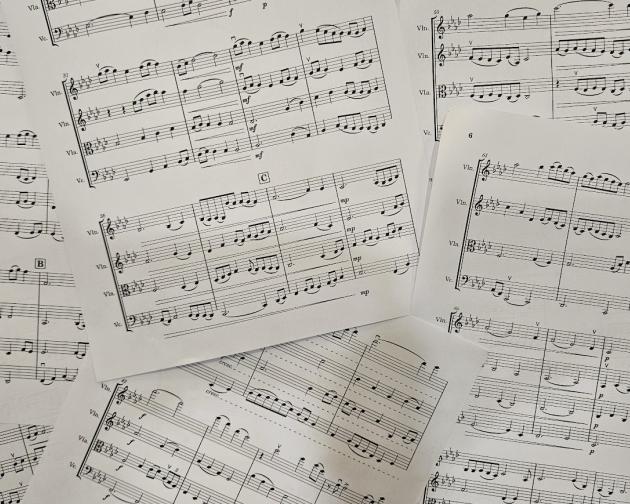
The majority of Composition Seminar is built upon our final composition, which sounds much more intimidating than it is. We have the fantastic opportunity to have our work performed by the students of the class, as well as to perform their original works! What this means is that we have a decent amount of time to write, discuss, and rehearse our works with our performers. If you've ever composed, you may know this is one of the best opportunities you can have. With the student performers in mind, I took the challenge upon myself to use only the instruments and voices we have in the class, as well as to use all the instruments and voices we have in the class. Since putting 10 student performers of varying instrumentations in the same piece at the same time would be messy, I decided to mix up our fantastic students throughout a 9-movement work. When I visited the Albertina here in Vienna, I saw a palace room that had sculptures of Apollo and the nine Muses. I find that I absolutely love to write music alongside a story, myth, poem, or some kind of external idea - writing music in a way that can tell a story is something that I find greatly fulfilling. From here, my idea for my final composition was born. Each movement of the piece follows the symbolism of a different Muse, and each movement utilizes 1-4 of the students, depending on the mood and ideas surrounding the Muse. I've worked on this composition for the past two months, and have finally been able to send it to our wonderful student performers (of whom I am eternally grateful for).
In a bout of reflection, I realized this kind of opportunity, inspiration, and time dedicated to composition is not really one that I had often in my own studies back home. Even in composition-based classes, we had a greater number of compositions to complete, leaving less and less time dedicated to each. While I am in no way unhappy with that time and the works I was able to create, the structure here in Vienna offers a completely different way for me to indulge in my craft while being endlessly inspired by the beautiful city and new experiences around me. I think, even with all my ideas, it would be a shame to not grasp this time and inspiration while I can (study abroad truly only lasts so long).
The World of Dissecting and Understanding
I consider two of my other classes with IES Abroad Vienna to fall under the umbrella of musical dissection. Mainly, partaking in the Music Research Internship has offered me a new look into research and how to build a timeline of a composer through a history of music performances, residencies, and figuring out when and how compositions themselves came to be. Back in the States, this experience is closest to my studies of music history. However, these courses were hardly ever hands-on. There was so much to cover, and rarely did we get the opportunity to conduct research and to uncover. My own personal work with my mentor back home, however, has given me great preparation for my internship here - my mentor and I are moving constantly to explore, discover, and promote the life and works of a forgotten composer of the past. These experiences differ mostly in content, where my mentor and I focused more on rewriting and publishing the music we found, and here my focus has become filling in the gaps of a widely-known and loved composer. The internship overall has allowed me to realize that, even with musicians and composers of household names, there is always so much work that can be done, and the work gets done by, as my professor puts it, "whoever cares enough to get it done first and completely".
My other "dissection-based" course is Film Music. I am a double major, so I study Music as well as Cinema & Media Studies - Film Music was exactly where I wanted to be. This course has been greatly enjoyable for me, diving into the world of film history and the development and changes of the world of music within it by exploring films themselves (usually in brief clips, sometimes in whole films) even in our own assignments, where we explore the music from scenes and films of our choice! Back at my home college, there aren't many classes like this. There are a couple of courses dedicated to the study and exploration of music in media, and various courses exploring film history and music history, but nothing quite like the history of film music. I find it fantastic that I could find a course as specific and dedicated as this one, where I can surround myself in my interests while constantly learning new and fascinating subjects.
The World of Practice and Performance
In my final musical world, I found the greatest changes and resurfacing struggles. In my violin studies, I grew up without a solid set of fundamentals. My first private teacher was a family member who hadn't played in years. My second teacher, who I stuck with for most of my violin career, was great, but I was a stubborn child who weaved in and out of wanting private lessons. When I finally committed to continuing to work with him, COVID had hit soon after, and our lessons now had to be virtual (truly, a personally terrible way to learn an instrument). When I came to college, these fundamental problems caught up with me quickly. I found myself lacking in comparison with my peers, but still had no real lust for performance. My first teacher at my college knew this, and was a fantastic and reliable teacher for getting me to a place where I would be working and reworking my fundamentals while ensuring the music I practiced and performed kept me interested and engaged in this world.
Unfortunately, her time as a professor was cut short, just as I felt I was truly getting somewhere in my performance studies. My new professor I have only worked with one semester before coming to Vienna, and I had never practiced more than I have during said semester. He wasted no time in focusing on my fundamentals, regardless of the music and exercises they were met with. I knew I was progressing, but I wasn't wholly satisfied - I felt constantly frustrated with myself for not being able to adjust to new fundamentals quickly. But the semester ended sooner than it had felt it was going to, and my next destination was far, far away. Of course, this meant I would have yet another new teacher. And again, the adjustment was harsher than I expected.
I thought I had brought what I had learned from last semester with me to my new lessons, with my new teacher, in my new city, country, continent. But it was quickly brought up that much of what I was doing just wasn't necessary to serve the music. And, again, I would be focusing entirely on relearning my fundamentals. Only, this time, I wouldn't be preparing for any end-of-semester performances like I would have to back at my home college, so I'm able to work entirely, truly entirely, on my fundamentals. Like one can imagine from any experience relearning something that you've been learning for over ten years, it was unfortunately extremely frustrating. My lessons started great and my new teacher was patient; the block I was feeling came purely from myself and my frustrations with my personally perceived lack of progress.
I felt a pull to reach out to my first college violin instructor. She had always been so patient with me and worked with me to ensure I always felt good, in one way or another, about the music I had the opportunity and capability to perform. She, in her consistent good spirits and grace, responded immediately, even with our extremely different time-zones. She offered some good advice off the bat in her written response, but graciously offered to video call and discuss further what was really bothering me about performance and practical studies. When I was able to talk to her one-on-one, as I have often found to be true, she met me with gentle support and lovely new perspectives.
"It's like learning a third language", I remember her saying. "Each teacher has their own methods, and each one will teach you in their own 'language'".
It had started to make sense to me. If, during my college career, her methods were my first language, my professor last semester (and the one I will return to after this semester) would be my second, and my new teacher would be my third.
"Take what you like from each language, what really helps you, and use it in your own voice."
My frustrations would ease over the next few weeks. Yes, I was relearning fundamentals again, but in a way that was completely new, which meant I would be expanding my musical vocabulary - becoming "multilingual" in the various methods of violin practice and performance that I had the incredible opportunity to study. Eventually, in my own time and by my own hands, I will be able to "speak" these different methods fluently, and I would be able to understand what serves me, my music, and, ultimately, my voice.
Really, studying music abroad is not so scary, and it's not so frighteningly different as I once had worried. It's more, it's hands-on, exciting, and filled with personal excursions, ups-and-downs, and developments. Working with new professors, in new landscapes and with new ideas, sort of lends itself to the idea of learning another language. Ultimately, in each and every new way to learn, explore, and develop your musical strengths, you are broadening your musical horizons one step at a time. And, ultimately, it's up to you to take what you like from each language you learn, to take what serves you and what serves your music, and to create your own voice. It is here, in this idea, that we truly become artists.
More Blogs From This Author


One Final Week in Vienna, Austria
When my semester abroad was coming to an end, I found there was a lot I still wanted to do in my host city. Here's how me and my dear friends spent our last...


Riley Dunbar
I am a composer who is always looking around me for my next inspiration. I love to find love all around me and share it with whoever I can. The world inspires me to write, draw, and perform; I hope the way I see it and portray it can inspire you too!